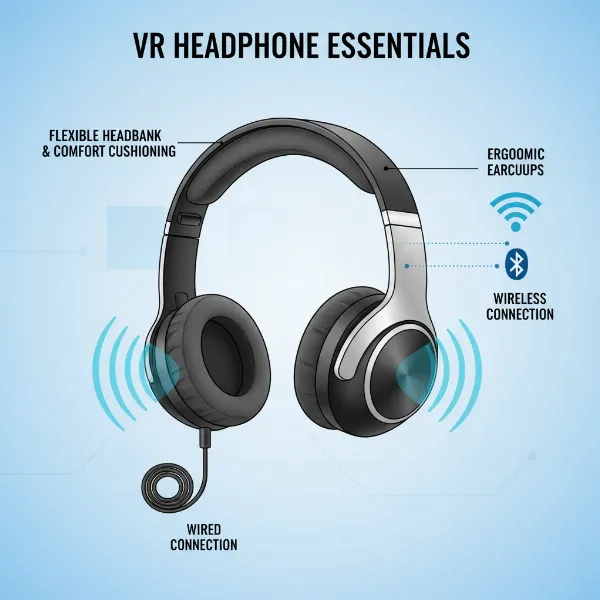
For many, swimming is a meditative escape or an intense workout, but the silence can sometimes feel monotonous. Imagine gliding through the water with your favorite playlist energizing every stroke or a podcast keeping your mind engaged. Waterproof headphones have revolutionized the swimming experience, transforming solitary laps into an immersive audio journey. However, unlike traditional headphones, those designed for the aquatic environment face unique challenges, from water ingress to signal transmission. Choosing the right pair means understanding specialized features that ensure your music flows as smoothly as you do through the water. This guide will help you navigate the options and find the ideal waterproof headphones to soundtrack your swims.
Understanding Waterproof Ratings: IPX7 vs. IPX8
When selecting any electronic device for water exposure, the Ingress Protection (IP) rating is paramount. This international standard indicates a device’s resistance to dust and liquids. For swimmers, the second digit, which pertains to liquid protection, is the most critical. You’ll often see an “X” in place of the first digit (e.g., IPX8), meaning the device has not been rated for dust protection, which is less relevant for underwater use.
The distinction between “water-resistant” and “waterproof” is vital. Many headphones are water-resistant, designed to withstand sweat or splashes, but they are not suitable for submersion. For true underwater performance, you need genuinely waterproof headphones.
- IPX7 Rating: A device with an IPX7 rating can be submerged in up to 1 meter (3.3 feet) of fresh water for 30 minutes. While this offers good protection against accidental drops, it is generally considered insufficient for continuous, active swimming, which involves deeper submersion and dynamic movement.
- IPX8 Rating: This is the gold standard for swimming headphones. An IPX8 rating guarantees continuous submersion beyond 1 meter. Manufacturers must specify the exact depth and duration (e.g., “up to 2 meters for 60 minutes”). Always check these specifics in the product manual to ensure it meets your swimming depth and duration needs.
Beyond the IP rating, remember that most IP testing is conducted in fresh water. Saltwater and chlorinated pool water can be more corrosive over time, even for highly rated devices. Always rinse your headphones with fresh water after swimming in the ocean or a pool. Additionally, avoid diving or high-impact water entry, as the sudden pressure can exceed tested conditions. Extreme temperatures, such as those found in hot tubs, can also compromise waterproof seals.
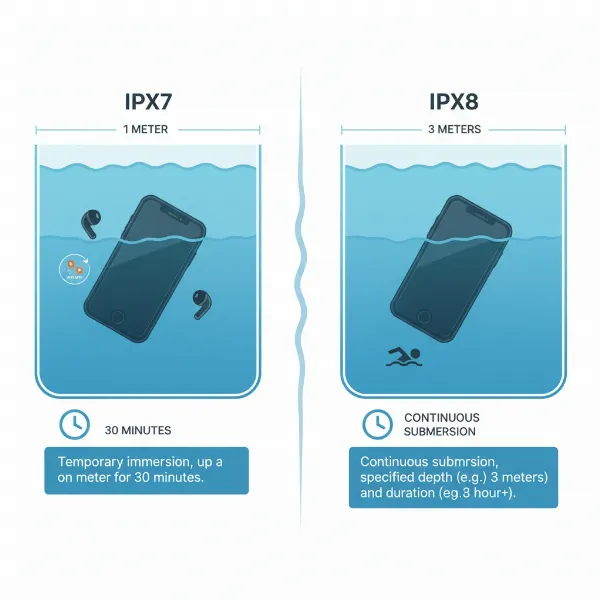 Illustration showing IPX7 and IPX8 ratings for waterproof headphones, with icons of submersion depth.
Types of Waterproof Headphones for Swimmers
The underwater environment poses significant challenges for sound transmission, leading to two primary headphone technologies adapted for swimming: bone conduction and sealed in-ear headphones. Each offers a distinct listening experience and set of benefits.
Bone Conduction Headphones
Bone conduction headphones are a groundbreaking technology that bypasses the eardrum entirely. Instead of traditional speakers, these devices use transducers that rest on your cheekbones, converting sound waves into subtle vibrations. These vibrations travel directly through your cranial bones to your inner ear, allowing you to hear audio without anything inside your ear canal.
- How They Work: The transducers create vibrations that are conducted through your bones to the cochlea, the part of the inner ear responsible for hearing. This means your ear canal remains open.
- Pros:
- Situational Awareness: Keeping your ear canals open allows you to hear ambient sounds, such as other swimmers, lifeguards, or coaches, making them a safer option, especially in open water.
- Comfort: For many, the open-ear design is more comfortable for long swim sessions, as there’s no pressure inside the ear canal or risk of water getting trapped. They often fit securely under a swim cap and goggles.
- Stability: The wraparound design, typical of most bone conduction models, tends to provide a very secure fit that withstands vigorous movement.
- Cons:
- Sound Profile: The sound quality, particularly bass response, can differ from traditional in-ear headphones. While clear and intelligible, the audio might sound less “full” underwater. Some users find that wearing earplugs can enhance the underwater sound by blocking external water noise.
- Sound Leakage: Depending on the volume, a small amount of sound may be audible to those nearby, though this is less of an issue underwater.
- Who They Are For: Ideal for swimmers who prioritize safety, comfort, and awareness of their surroundings. They are an excellent choice for open water swimmers, triathletes, and those who dislike the feeling of earbuds in their ears.
|
Our Picks for the Best headphone in 2026
As an Amazon Associate I earn from qualifying purchases.
|
||
| Num | Product | Action |
|---|---|---|
| 1 | Soundcore by Anker Q20i Hybrid Active Noise Cancelling Headphones, Wireless Over-Ear Bluetooth, 40H Long ANC Playtime, Hi-Res Audio, Big Bass, Customize via an App, Transparency Mode |

|
| 2 | Soundcore by Anker Q20i Hybrid Active Noise Cancelling Headphones, Wireless Over-Ear Bluetooth, 40H Long ANC Playtime, Hi-Res Audio, Big Bass, Customize via an App, Transparency Mode (White) |
|
| 3 | Sony WH-CH720N Noise Canceling Wireless Headphones Bluetooth Over The Ear Headset with Microphone and Alexa Built-in, Black New |
|
| 4 | Soundcore by Anker Q20i Hybrid Active Noise Cancelling Headphones, Wireless Over-Ear Bluetooth, 40H Long ANC Playtime, Hi-Res Audio, Big Bass, Customize via an App, Transparency Mode |
|
| 5 | Soundcore by Anker Q20i Hybrid Active Noise Cancelling Headphones, Wireless Over-Ear Bluetooth, 40H Long ANC Playtime, Hi-Res Audio, Big Bass, Customize via an App, Transparency Mode (Pink) |
|
| 6 | Amazon Basics On Ear Wired Computer Headset with Adjustable Microphone, 3.5mm Port or in-Line Control with USB-A Port, Foldable, Clear Sound, Small/Medium Size, Black |
|
| 7 | Amazon Basics Bluetooth On-Ear Headphones Wireless with Microphone, Deep Bass, 35 Hour Playtime, Foldable, Collapsible, Portable Travel Friendly, Black |
|
| 8 | Sony WH-CH720N Noise Canceling Wireless Headphones Bluetooth Over The Ear Headset with Microphone, Pink |
|
| 9 | Amazon Basics Hybrid Active Noise Cancelling Headphones, 35 Hours Playtime with ANC on and 45 Hours with ANC Off, Wireless, Over Ear Comfortable Fit, Bluetooth, One Size, Black |
|
| 10 | Sony WH-CH720N Noise Canceling Wireless Headphones Bluetooth Over The Ear Headset with Microphone and Alexa Built-in, White New |
|
In-Ear Waterproof Headphones (Earbuds)
Some waterproof in-ear headphones are specifically designed for swimming, featuring robust sealing mechanisms and hydrophobic coatings to protect against water ingress. These function more like traditional earbuds but with enhanced waterproofing.
- How They Work: These headphones create a tight seal within the ear canal, both to prevent water from entering and to provide acoustic isolation.
- Pros:
- Potentially Superior Sound Fidelity: When a good seal is achieved, in-ear headphones can deliver a more traditional and often richer audio experience, particularly in terms of bass, by directly channeling sound into the ear.
- Noise Isolation: The tight seal effectively blocks out ambient noise, which can be beneficial for focusing solely on your music.
- Cons:
- Fit Challenges: Achieving and maintaining a perfect watertight seal is crucial and can be difficult for some users. A poor fit can lead to water leakage, discomfort, or the earbuds dislodging during intense strokes or flip turns.
- Water Trapping & Hygiene: Water can sometimes get trapped behind the earbud, leading to discomfort or potentially ear infections if not properly dried.
- Reduced Situational Awareness: The noise-isolating design significantly reduces your ability to hear external sounds, which can be a safety concern in busy pools or open water.
- Comfort: The pressure from the earbud seal can be uncomfortable for some during extended wear.
- Who They Are For: Best suited for swimmers who prioritize audio quality and noise isolation above all else, and who can achieve a consistently secure and comfortable fit with in-ear devices.
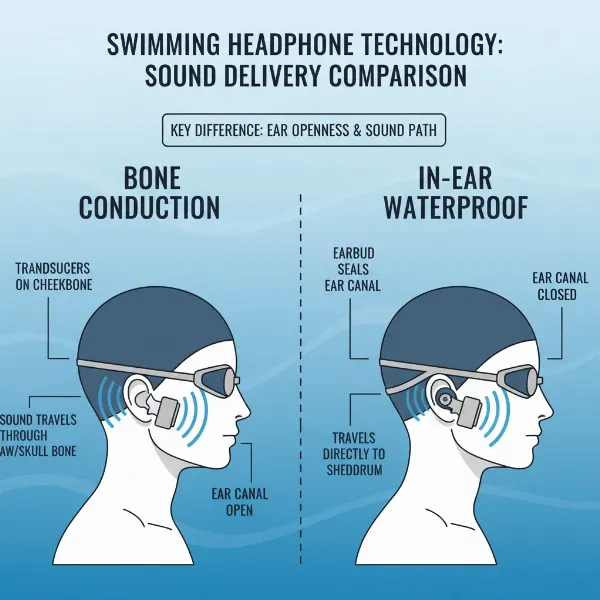 Side-by-side comparison of bone conduction and in-ear waterproof headphones for swimming.
Key Factors When Choosing Swimming Headphones
Selecting the best waterproof headphones involves more than just their IP rating. Several other factors significantly impact performance, comfort, and overall enjoyment in the water.
Connectivity and Storage: The Bluetooth Dilemma
One of the most critical aspects of swimming headphones is how they receive audio. Bluetooth radio waves (operating at 2.4 GHz) are severely attenuated by water and cannot transmit effectively even a few centimeters underwater. This means that “Bluetooth swimming headphones” cannot stream music wirelessly from your phone or smartwatch while submerged.
- Onboard MP3 Storage: For this reason, nearly all effective swimming headphones feature built-in memory (typically 4GB to 32GB) to store MP3 or AAC audio files. You transfer music directly to the device via a USB connection to your computer, allowing for phone-free listening underwater. This is the most reliable method for aquatic audio.
- Hybrid Functionality: Some premium models offer dual functionality, acting as standalone MP3 players for swimming and standard Bluetooth headphones for use out of the water (e.g., running or cycling). This versatility can be a significant advantage for multi-sport athletes.
Sound Quality Underwater
The physics of sound transmission changes dramatically underwater. Water is approximately 800 times denser than air, which dampens high-frequency sounds and alters how audio is perceived.
- Bone Conduction: Expect clear, intelligible audio that is excellent for podcasts, audiobooks, and rhythm-based music. While deep bass may be less prominent than with traditional headphones, the clarity for vocal tracks and consistent beats is often impressive.
- In-Ear Monitors: These models aim to counteract water’s dampening effect by emphasizing a strong low-frequency response and providing excellent acoustic isolation through a secure seal. A good seal is paramount for high-quality sound from in-ear swimming headphones.
Comfort and Secure Fit
A secure and comfortable fit is non-negotiable for swimming headphones. The forces exerted during flip turns, vigorous strokes, or even just pushing off the wall can easily dislodge poorly fitted devices.
- Design Elements: Look for designs that prioritize stability. Many bone conduction models feature a lightweight, flexible neckband that wraps around the back of your head, often made from silicone or titanium alloy. In-ear options may include over-the-ear hooks or multiple ear tip sizes to ensure a snug fit.
- Goggle and Cap Compatibility: The best swimming headphones are designed to integrate seamlessly with your swim cap and goggles, resting comfortably without causing excessive drag or pressure.
Battery Life
Since you can’t charge headphones mid-swim, long battery life is essential. Most quality swimming headphones offer between 6 to 10 hours of continuous playback on a single charge. Consider your typical swim duration and frequency to ensure your chosen model can last through multiple sessions without needing a recharge. Features like quick charging can also be a valuable convenience.
Durability and Materials
Beyond the IPX8 rating, the overall construction and materials contribute significantly to a headphone’s longevity. Look for robust, corrosion-resistant materials like medical-grade silicone and durable plastics or titanium frames. They should be able to withstand the harshness of pool chemicals and saltwater, as well as regular wear and tear.
Controls and User Experience
With wet, pruned fingers, intricate touch controls are impractical underwater. Physical, tactile buttons are a must for swimming headphones.
- Button Design: Seek large, raised, and distinctly shaped buttons for essential functions like play/pause, track skipping, and volume control. Audible feedback tones can also be helpful.
- Ease of Use: The interface should be intuitive, allowing you to control your audio without breaking your rhythm or needing to stop.
Safety Features
While bone conduction naturally offers situational awareness, some models include additional safety features. For instance, some headphones are designed to be slightly buoyant, preventing them from sinking to the bottom of the pool or drifting away in open water if they happen to come off. This small detail can be a significant advantage.
Bảng So Sánh Các Mẫu Headphone Tốt Nhất Hiện Nay
Choosing the ideal waterproof headphones can greatly enhance your swimming experience. Here’s a comparison of some highly-rated models, highlighting their strengths for different types of swimmers.
| Feature / Model | Shokz OpenSwim Pro | H2O Audio TRI PRO Multi-Sport | FINIS Duo | SYRYN MP3 Player (In-Ear) |
|---|---|---|---|---|
| Technology | Bone Conduction | Bone Conduction | Bone Conduction | In-Ear |
| Waterproof Rating | IP68 | IPX8 | IPX8 | IPX8 |
| Connectivity | MP3 Player (8GB), Bluetooth (out of water) | MP3 Player (8GB), Bluetooth (out of water) | MP3 Player (4GB), No Bluetooth | MP3 Player (8GB), No Bluetooth |
| Battery Life | Up to 8 hours | Up to 7 hours | Up to 7 hours | Up to 10 hours |
| Sound Quality | Clear, crisp underwater audio; good for podcasts | Good clarity, balanced | Excellent for bone conduction | Strong bass, good isolation (if sealed well) |
| Comfort & Fit | Lightweight, secure under cap/goggles | Secure, goggle-integrated design | Attaches to goggle straps | Multiple ear tip sizes for secure fit |
| Key Advantage | Versatile for swimming and land sports, comfortable | Designed for multi-sport, secure fit with goggles | Excellent sound quality for bone conduction | High storage, strong in-ear audio |
| Best For | Triathletes, casual and serious swimmers | Multi-sport athletes, serious lap swimmers | Swimmers prioritizing bone conduction audio | Swimmers preferring in-ear sound and isolation |
Note: The Shokz OpenSwim is purely an MP3 player without Bluetooth, while the OpenSwim Pro adds Bluetooth for land use, making it more versatile.
Hướng Dẫn Mua Headphone (Buying Guide)
Navigating the market for waterproof headphones can be overwhelming. Follow these steps to make an informed decision and find the pair that perfectly matches your swimming needs.
Xác Định Nhu Cầu Sử Dụng (Identify Your Usage Needs)
Start by considering how and where you’ll be using your headphones.
- Purpose: Are you primarily listening to music for motivation during lap swimming, enjoying audiobooks or podcasts, or do you need them for open water training where situational awareness is key?
- Music Preference: Do you prefer powerful bass and immersive sound, or is clear, intelligible audio sufficient?
- Features: Do you need a dedicated MP3 player, or would a hybrid model with Bluetooth for out-of-water use be more beneficial? Do you require hands-free calling capabilities (though unlikely for swimming) or app integration?
Xác Định Ngân Sách (Determine Your Budget)
Waterproof headphones for swimming vary widely in price. Establishing a budget early on will help narrow down your options.
- Entry-Level (Under $100): You can find reliable, basic MP3 swimming headphones with good waterproofing. These are often sufficient for casual swimmers.
- Mid-Range ($100-$200): This segment offers improved sound quality, better battery life, more advanced designs, and often hybrid functionality (MP3 + Bluetooth).
- Premium (Above $200): Expect the highest quality audio, exceptional comfort, durable materials, and advanced features like greater storage or specialized multi-sport designs.
Tìm Hiểu Về Các Thương Hiệu Headphone Uy Tín (Research Reputable Brands)
Certain brands have established themselves as leaders in the waterproof audio space.
- Shokz (formerly AfterShokz): Renowned for their bone conduction technology, offering comfortable and reliable swimming headphones like the OpenSwim series. They are a go-to for many swimmers and multi-sport athletes.
- H2O Audio: Specializes in aquatic audio, offering a range of bone conduction and in-ear options designed specifically for water sports. Their products often focus on secure fit and goggle integration.
- FINIS: Known for integrating audio solutions directly into swimming gear, often featuring bone conduction technology designed for competitive training.
- JBL, Creative, Sony (for certain hybrid models): While not exclusively swimming brands, some of their waterproof models offer compelling features for swimmers who might also use them for other sports.
Đọc Các Bài Đánh Giá và So Sánh (Read Reviews and Comparisons)
Before making a purchase, thoroughly research potential models.
- Trusted Sources: Look for reviews from reputable tech sites, swimming publications, and user forums (like Reddit communities) where real swimmers share their experiences.
- Focus on Key Criteria: Pay close attention to feedback regarding real-world waterproof performance, underwater sound quality, comfort during long swims, battery life, and the functionality of physical controls.
- Identify Common Issues: Look for recurring complaints about fit, durability, or difficulties with music transfer.
Thử Headphone Trực Tiếp (Nếu Có Thể) (Try Headphones Directly If Possible)
If possible, visit a store that allows you to try on different models.
- Feel the Fit: Even if you can’t test them in water, assess how they feel on your head and around your ears. Imagine wearing them with a swim cap and goggles. A comfortable, secure fit is crucial.
- Assess Controls: Get a sense of the button placement and tactile feedback. Can you easily operate them without looking?
Mua Headphone Từ Các Cửa Hàng Uy Tín (Purchase from Reputable Stores)
Always buy your waterproof headphones from authorized dealers or reputable retailers.
- Warranty and Return Policy: Ensure the store offers a clear warranty and a flexible return policy in case the headphones don’t meet your expectations or develop an issue.
- Product Authenticity: Buying from trusted sources helps ensure you receive a genuine product with the advertised specifications and warranty.
- Check the Product: Before finalizing your purchase, inspect the packaging and the headphones themselves for any signs of damage or tampering.
Conclusion
Choosing the best waterproof headphones for swimming empowers you to transform your aquatic workouts from routine laps into an engaging, rhythm-driven experience. The journey begins with understanding the critical IPX8 waterproof rating and the distinct advantages of bone conduction versus sealed in-ear designs. Prioritize models with reliable onboard MP3 storage, a comfortable and secure fit that endures vigorous movement, and intuitive physical controls.
Whether you’re a casual swimmer seeking motivation or a dedicated athlete aiming to boost performance, the right pair of waterproof headphones can make all the difference. By carefully considering your needs and the options available, you’ll find a device that not only survives the water but helps you thrive in it. So, are you ready to dive in and let the music move you through every stroke?
Frequently Asked Questions
Do Bluetooth headphones work underwater for swimming?
No, Bluetooth radio waves cannot effectively transmit through water. For listening to music while swimming, you need headphones with integrated MP3 storage, allowing you to load music directly onto the device for playback underwater.
What IP rating do I need for swimming headphones?
For true swimming and submersion, you need a minimum of an IPX8 rating. An IPX7 rating is generally for accidental drops and splashes, but not for continuous underwater use during active swimming. Always check the manufacturer’s specified depth and duration for IPX8 devices.
Are bone conduction headphones better than in-ear for swimming?
Bone conduction headphones are often preferred for swimming because they keep your ears open, providing situational awareness and better comfort for many users. While in-ear options can offer higher fidelity, they require a perfect seal to prevent water ingress and can reduce awareness of your surroundings. The “better” choice depends on your personal preferences for comfort, sound, and safety.
How do I put music on my swimming headphones?
Most swimming headphones with internal storage connect to your computer via a USB cable. The device will typically appear as an external drive, allowing you to drag and drop MP3 or AAC audio files directly onto its memory.
Can I use my swimming headphones in saltwater or chlorinated pools?
Yes, most IPX8-rated swimming headphones are designed for use in both chlorinated pools and saltwater. However, it is crucial to rinse your headphones thoroughly with fresh water immediately after each use in corrosive environments to prevent long-term damage and corrosion to the seals and materials.