In today’s interconnected world, where virtual meetings and calls are the norm, clear communication is paramount. Whether you’re collaborating with colleagues across continents or presenting to clients from your home office, a high-quality headphone is no longer a luxury but a necessity. The right pair can transform a noisy, distracting environment into a focused workspace, ensuring your voice is heard crystal clear and you can concentrate without interruption. This comprehensive guide will walk you through the various types of headphones, the crucial features to consider, and provide top recommendations to help you select the perfect audio companion for your office calls and Zoom meetings.
Types of Headphones for Professional Use
The market offers a wide array of headphones, each designed with specific strengths. Understanding these differences is the first step in finding your ideal match for professional communication.
Over-Ear Headphones
Over-ear headphones, also known as circumaural headphones, fully enclose your ears with large, cushioned earcups.
- Pros: They generally offer superior Active Noise Cancellation (ANC), providing an immersive audio experience perfect for deep focus. Their larger size often allows for more substantial batteries and more powerful drivers, contributing to both longer use and excellent sound quality for both calls and music. Comfort is also a highlight, as the weight is distributed over a larger area around the ear, making them suitable for prolonged wear.
- Cons: Over-ear models can be bulky and less portable. They might cause ear sweat during extended use, and for those who wear glasses, the earpads can press against the arms of the glasses, potentially breaking the seal and reducing sound isolation or comfort.
- Best for: Professionals who need maximum noise isolation, deep focus, and an immersive audio experience for long hours, such as developers, writers, or remote workers in noisy home environments.
|
Our Picks for the Best headphone in 2026
As an Amazon Associate I earn from qualifying purchases.
|
||
| Num | Product | Action |
|---|---|---|
| 1 | Sony WH-CH720N Noise Canceling Wireless Headphones Bluetooth Over The Ear Headset with Microphone, Pink |

|
| 2 | Soundcore by Anker Q20i Hybrid Active Noise Cancelling Headphones, Wireless Over-Ear Bluetooth, 40H Long ANC Playtime, Hi-Res Audio, Big Bass, Customize via an App, Transparency Mode |
|
| 3 | Soundcore by Anker Q20i Hybrid Active Noise Cancelling Headphones, Wireless Over-Ear Bluetooth, 40H Long ANC Playtime, Hi-Res Audio, Big Bass, Customize via an App, Transparency Mode (Pink) |
|
| 4 | Sony WH-CH720N Noise Canceling Wireless Headphones Bluetooth Over The Ear Headset with Microphone and Alexa Built-in, White New |
|
| 5 | Amazon Basics On Ear Wired Computer Headset with Adjustable Microphone, 3.5mm Port or in-Line Control with USB-A Port, Foldable, Clear Sound, Small/Medium Size, Black |
|
| 6 | Sony WH-CH720N Noise Canceling Wireless Headphones Bluetooth Over The Ear Headset with Microphone and Alexa Built-in, Black New |
|
| 7 | Amazon Basics Bluetooth On-Ear Headphones Wireless with Microphone, Deep Bass, 35 Hour Playtime, Foldable, Collapsible, Portable Travel Friendly, Black |
|
| 8 | Soundcore by Anker Q20i Hybrid Active Noise Cancelling Headphones, Wireless Over-Ear Bluetooth, 40H Long ANC Playtime, Hi-Res Audio, Big Bass, Customize via an App, Transparency Mode (White) |
|
| 9 | Soundcore by Anker Q20i Hybrid Active Noise Cancelling Headphones, Wireless Over-Ear Bluetooth, 40H Long ANC Playtime, Hi-Res Audio, Big Bass, Customize via an App, Transparency Mode |
|
| 10 | Amazon Basics Hybrid Active Noise Cancelling Headphones, 35 Hours Playtime with ANC on and 45 Hours with ANC Off, Wireless, Over Ear Comfortable Fit, Bluetooth, One Size, Black |
|
On-Ear Headphones
On-ear headphones, or supra-aural headphones, sit directly on top of your ears rather than enclosing them.
- Pros: They are typically lighter and more compact than over-ear headphones, making them more portable. While they offer less passive noise isolation, many models still include effective ANC. This design allows for some environmental awareness, which can be beneficial in certain office settings where you need to hear announcements or colleagues.
- Cons: The direct pressure on the ears can become uncomfortable for some users during very long sessions. Their noise isolation capability is usually a step below over-ear models.
- Best for: Hybrid workers or those in moderately noisy open-plan offices who need a balance between portability, comfort, and the ability to remain somewhat aware of their surroundings.
In-Ear Headphones (Earbuds)
In-ear headphones, commonly known as earbuds, are small and fit directly into your ear canal. True wireless earbuds have become immensely popular for their ultimate portability.
- Pros: They are incredibly discreet and portable, ideal for professionals constantly on the move or those who prefer an almost invisible audio solution. Many modern earbuds now feature impressive ANC and microphone quality, making them surprisingly capable for calls.
- Cons: Earbuds typically have shorter battery life compared to over-ear or on-ear headphones, especially with ANC enabled. Microphone performance, while improving, can still suffer in very noisy environments as the mic is further from the mouth. They may also not be as comfortable for everyone during all-day wear due to pressure inside the ear canal.
- Best for: Professionals who prioritize portability, discretion, and quick, spontaneous calls, such as frequent travelers or those who move between different workspaces.
Specialized Business Headsets (with Boom Mics)
These headsets are purpose-built for communication, featuring a dedicated boom microphone that extends closer to your mouth.
- Pros: They offer superior microphone quality and noise cancellation, making your voice exceptionally clear even in chaotic environments. The boom mic often includes a convenient flip-to-mute function. Many are certified for Unified Communications (UC) platforms like Zoom and Microsoft Teams, ensuring seamless integration and optimal performance.
- Cons: The aesthetic is often less “stylish” than consumer headphones and can appear more utilitarian. They might be perceived as bulky by some users.
- Best for: Professionals in call-intensive roles, customer service, or those working in extremely noisy open offices or call centers where crystal-clear outgoing audio is the top priority.
Open-Ear Headphones
Open-ear headphones, including bone conduction and open-fit designs, sit outside the ear canal, allowing you to hear your surroundings naturally.
- Pros: They excel at maintaining situational awareness, which is vital for roles requiring interaction with the physical environment. They eliminate ear fatigue and heat build-up associated with in-ear or over-ear designs.
- Cons: They offer no noise isolation for the listener, making them unsuitable for noisy environments if you need to focus. Audio quality for music can also be less immersive, and bass response is often limited. Microphone quality varies but can be good for calls.
- Best for: Office managers, supervisors, or anyone who needs to be constantly aware of their environment while still participating in calls and listening to audio, like those in a shared office space or at home with children.
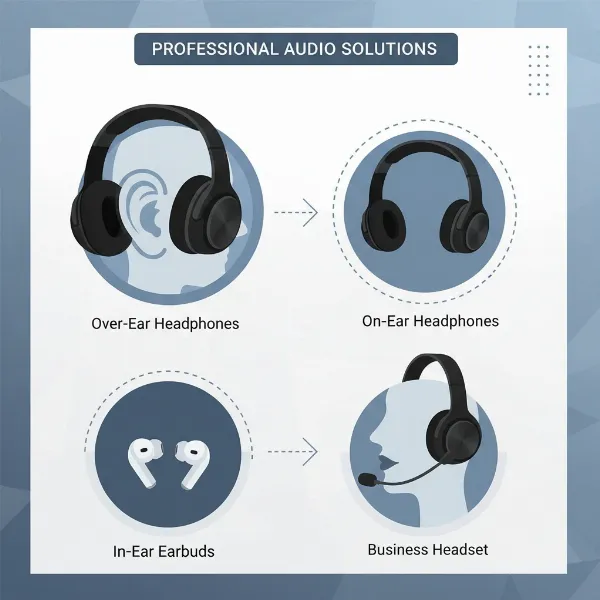 Illustrations of over-ear, on-ear, in-ear, and boom mic headsets for office calls
Essential Factors When Choosing Headphones for Calls
Selecting the Best Headphones For Office Calls And Zoom involves more than just picking a popular brand. Critical features determine how well they perform in a professional setting.
Microphone Quality and Noise Cancellation
The microphone is arguably the most crucial component for professional calls. A good microphone ensures your voice is clear and free from distracting background noise.
- Boom Mics vs. Integrated Mics: Boom microphones, typically found on specialized headsets, offer the best voice clarity by positioning the mic directly in front of your mouth. They are highly effective at isolating your voice from ambient sounds. Integrated microphones, common in consumer headphones and earbuds, have improved significantly with multi-mic arrays and AI-powered noise rejection, but may still struggle in very loud environments compared to a dedicated boom mic.
- Microphone Environmental Noise Cancellation (ENC): This technology actively works to filter out background noise (like keyboard typing, barking dogs, or office chatter) from your outgoing audio, ensuring your colleagues only hear your voice.
- Flip-to-Mute: A physical boom mic that automatically mutes when flipped up provides intuitive and reliable control, preventing accidental audio leaks during meetings.
Active Noise Cancellation (ANC)
ANC technology uses microphones to detect ambient noise and then generates an inverse sound wave to cancel it out, providing quiet for the listener.
- Benefits for Work: High-quality ANC allows you to concentrate better in noisy environments, whether it’s a bustling office, a busy cafe, or a loud home. It reduces distractions, improves listening comprehension, and enhances overall focus during calls or when working on tasks requiring deep concentration.
 Professional focused on work with noise-canceling headphones in a busy office environment
Comfort for Long Wear
For professionals who spend hours on calls, comfort is non-negotiable.
- Materials and Design: Look for soft, breathable earcup materials (like memory foam or protein leather) and an adjustable, padded headband for over-ear and on-ear models. Lightweight designs reduce strain.
- Fit: Ensure the clamping force is firm enough to stay secure but not so tight that it causes discomfort. For glasses wearers, some over-ear headphones might pinch, so testing the fit is crucial. Earbuds should offer multiple tip sizes for a secure yet gentle fit.
Battery Life
Wireless freedom is key for productivity, so battery life is a significant consideration.
- Talk Time vs. Music Playback: Pay attention to both specifications. Many modern headphones offer 20-30+ hours of music playback, which translates to a good amount of talk time.
- Fast Charging & Use While Charging: Features like fast charging can provide several hours of use from a short charge, and the ability to use headphones while they are charging (especially via USB-C) is a huge convenience.
Connectivity and Compatibility
Seamless connectivity ensures you’re always ready for your next call.
- Bluetooth Standards: Look for recent Bluetooth versions (e.g., Bluetooth 5.2 or 5.3) for stable connections, improved range, and power efficiency. Support for high-quality codecs like aptX or LDAC can enhance audio for music.
- Multi-Device Pairing (Multipoint): This allows your headphones to connect to two devices simultaneously (e.g., your laptop and smartphone), enabling seamless switching between a video call on your computer and an incoming phone call.
- USB Dongles: Many professional headsets include a dedicated USB dongle that plugs into your computer, offering a more stable and lower-latency connection than standard Bluetooth, specifically optimized for UC applications.
- Wired Options: A 3.5mm audio jack or USB-C wired connection can be a reliable fallback for zero-latency audio and microphone use, or when battery runs out.
Additional Features
Small details can make a big difference in your daily workflow.
- Integrated Controls: Easy-to-reach buttons for volume, mute, call answer/end, and ANC toggling are highly convenient.
- Companion Apps: Many brands offer smartphone apps that allow you to customize sound profiles (EQ), adjust ANC levels, update firmware, and fine-tune microphone settings.
- Durability and Build Quality: Look for robust materials and construction that can withstand daily use. IP ratings for sweat and water resistance can be a bonus for active professionals or accidental spills.
- UC Certification: Headphones certified for platforms like Microsoft Teams or Zoom guarantee optimal performance and compatibility, often featuring dedicated buttons for call control.
Top Headphone Recommendations for Office & Zoom Calls
Navigating the multitude of options can be daunting. Here are some of the best headphones and headsets currently available, catering to different needs and budgets, without direct citations to maintain a natural reading flow.
- For Overall Excellence in ANC & Mic:
- Sony WH-1000XM6/XM5 Series: Renowned for industry-leading active noise cancellation and impressive integrated microphone performance, even in noisy environments. They offer exceptional comfort for long periods and great sound for music.
- Bose QuietComfort Ultra Headphones: Often cited for their comfortable fit and highly effective noise cancellation. Their microphone system ensures clear voice pick-up for calls.
- For Dedicated Professional Calls (Boom Mic is Key):
- Jabra Evolve Series (e.g., Evolve2 85, Evolve2 75): These are purpose-built business headsets with excellent boom microphones that excel at isolating your voice from background noise. They are designed for all-day comfort and offer robust multi-device connectivity. The Evolve2 85 provides maximum immersion, while the Evolve2 75 offers a lighter on-ear fit.
- Poly Voyager Series (e.g., Voyager 4320, Voyager Focus 2): Poly (formerly Plantronics) headsets are staples in corporate environments. They feature advanced microphone noise cancellation (like Acoustic Fence technology) and are designed for comfort and ease of use with UC platforms, often including a USB dongle for reliable PC connection.
- For Excellent Mid-Range Value:
- Anker Soundcore Space Q45 Wireless: Offers very good active noise cancellation and decent microphone quality at a more accessible price point. They are comfortable and have solid battery life, making them a strong contender for hybrid workers.
- Razer Barracuda Pro Wireless: While often associated with gaming, these headphones feature strong ANC and a capable integrated microphone that performs well for office calls. They also boast impressive battery life and multi-device connectivity.
- For Budget-Conscious Professionals:
- Anker Soundcore Life Q20 2024: Provides surprisingly good ANC for its price and a comfortable fit. While the microphone might not match premium options in very loud settings, it’s a significant upgrade over basic headphones for clear calls.
- For Discreet & Portable Earbud Solutions:
- Technics EAH-AZ80/AZ100: These earbuds offer robust ANC, excellent sound quality, and surprisingly good microphone performance, especially the AZ100. They also support multi-point Bluetooth for seamless device switching.
- Apple AirPods Pro 3 (for iPhone users): If you’re deeply integrated into the Apple ecosystem, the AirPods Pro offer excellent noise cancellation, clear call quality, and seamless device switching between Apple products.
- For Situational Awareness:
- Shokz OpenComm2 UC / OpenFit: Utilizing bone conduction or open-fit design, these headphones keep your ears open to your surroundings while providing clear audio and a good boom microphone (on OpenComm2 UC) for calls. They are perfect for those who need to stay connected to their environment.
Buying Guide: How to Choose Your Perfect Office Headphones
With so many excellent options, making the final decision requires a systematic approach tailored to your specific needs.
1. Define Your Usage Needs and Environment
Start by asking yourself:
- What is your primary use? Are you on back-to-back calls all day, or just a few meetings interspersed with deep work and music?
- What is your work environment like? Is it a quiet home office, a bustling open-plan office, a shared co-working space, or do you frequently work in cafes and on public transport?
- What features are non-negotiable? Is top-tier mic clarity essential, or is deep noise cancellation for yourself more important? Do you need to connect to multiple devices seamlessly?
Your answers will quickly narrow down the suitable categories (over-ear, in-ear, boom mic headset, etc.).
2. Determine Your Budget
Headphones for professional use range widely in price.
- Entry-level (Under $100): You can find decent wired or basic wireless options with acceptable mic quality and some comfort. ANC might be present but less effective.
- Mid-range ($100 – $250): This segment offers a great balance of features, including good ANC, reliable microphone performance, comfortable designs, and solid battery life. Many strong contenders exist here.
- Premium ($250+): Expect top-tier ANC, superior microphone systems (often with advanced AI processing), premium build materials, exceptional comfort, and a comprehensive suite of features like advanced multipoint, app customization, and longer battery life.
Consider your investment as a tool for productivity and well-being. A slightly higher investment can yield significant returns in comfort and reduced frustration.
3. Research Reputable Brands
Focus on brands with a proven track record in professional audio or high-quality consumer electronics.
- Jabra and Poly (formerly Plantronics): Leaders in dedicated business headsets, known for microphone clarity and UC integration.
- Sony and Bose: Dominant in premium consumer headphones with excellent ANC and increasingly capable integrated microphones.
- Anker (Soundcore): Offers strong value in the mid-range with impressive features for the price.
- Shokz: Pioneering open-ear and bone conduction technology, ideal for specific awareness needs.
4. Read Reviews and Watch Demos
Don’t just rely on marketing. Seek out independent reviews and, crucially, watch video reviews that include microphone tests in various environments. This will give you a realistic expectation of how your voice will sound to others. Pay attention to comments on comfort during extended wear and reliability of features like multipoint pairing.
5. Test for Comfort (If Possible)
If feasible, try on different models at a retail store. Wear them for at least 10-15 minutes to get a feel for the weight, clamping force, and earcup materials. If you wear glasses, test them with your glasses on. Comfort is highly subjective, and what works for one person might not work for another.
6. Consider Warranty and Customer Support
A good warranty and responsive customer service can save you headaches down the line. Look for brands known for their reliability and support infrastructure.
Conclusion
Choosing the best headphones for your office calls and Zoom meetings is a crucial decision for your daily productivity and communication effectiveness. By prioritizing microphone clarity, effective noise cancellation, all-day comfort, and seamless connectivity, you can find a device that not only meets but exceeds your professional demands. Remember, the goal is to enhance your ability to connect, focus, and be heard clearly, turning every virtual interaction into a productive and pleasant experience. Invest wisely, and you’ll unlock a new level of efficiency in your professional life.
What aspect of your current work-from-home setup do you find most challenging, and how do you think better headphones could help?
Frequently Asked Questions
Are gaming headsets good for Zoom calls?
Yes, many gaming headsets can be excellent for Zoom calls, primarily because they often feature high-quality boom microphones designed for clear in-game communication. This dedicated microphone design usually outperforms integrated mics found in many consumer headphones in terms of voice clarity and background noise rejection, making them a strong option for professional use.
Should I prioritize ANC or mic noise cancellation?
For office calls, microphone noise cancellation (ENC) should be your top priority. While Active Noise Cancellation (ANC) for your listening comfort is important, if your colleagues cannot hear you clearly over your background noise, the call’s purpose is undermined. Ideally, look for headphones that offer strong performance in both areas.
What is multipoint connectivity?
Multipoint connectivity allows your wireless headphones to connect to two or more devices simultaneously. This means you can be listening to music on your laptop and seamlessly switch to an incoming call on your smartphone without manually disconnecting and reconnecting, greatly enhancing convenience for multitasking professionals.
Are earbuds suitable for professional calls?
Yes, modern earbuds can be very suitable for professional calls, especially high-end models that feature advanced multi-microphone arrays and AI-powered noise reduction. They offer excellent portability and discretion. However, in extremely noisy environments, a dedicated headset with a boom microphone may still provide superior outgoing voice clarity.
How often should I charge my wireless headphones?
The charging frequency depends entirely on the headphone’s battery life and your usage. Most good wireless headphones for work offer 20-30+ hours of talk time, meaning you might only need to charge them every few days or once a week with typical daily use. Always check the manufacturer’s specifications for optimal charging practices.