In the intense world of gaming, every millisecond can be the difference between victory and defeat. Audio cues, from an enemy’s subtle footsteps to the distinct reload of a weapon, are critical for competitive advantage. This often leads gamers to a fundamental question: which provides the superior experience, a wired or wireless gaming headset? While both offer unique benefits, the heart of this debate frequently comes down to one crucial technicality: latency.
This article delves deep into the latency differences between wired and various wireless gaming headsets. We’ll break down the technology, present real-world latency test results, explore the pros and cons of each connection type, and ultimately help you decide which headset truly aligns with your gaming style and priorities. Let’s unplug the myths and wire into the facts.
Understanding Latency in Gaming Headsets
Latency, in the simplest terms, is the delay between an action occurring in your game and you hearing the corresponding sound. For gamers, this delay is more than just a minor annoyance; it directly impacts reaction time and overall performance. Imagine playing a fast-paced shooter: if your headset has high latency, you might hear enemy footsteps or a gunshot too late, putting you at a significant disadvantage. In rhythm games, even a slight delay can completely throw off your timing.
The human ear generally perceives delays above 50-80 milliseconds (ms). Anything below this threshold is often considered imperceptible to most people, meaning that while a technical delay exists, your brain won’t register it as “lag.” Understanding this threshold is key to evaluating the real-world impact of different headset types.
Wired Gaming Headsets: Unmatched Speed and Reliability
Wired gaming headsets have long been the gold standard for competitive players, and for good reason. They offer a direct, physical connection that minimizes any potential for audio delay.
How Wired Headsets Achieve Near-Zero Latency
The primary advantage of a wired headset lies in its direct analog connection. The audio signal travels instantly through the cable, bypassing the complex encoding, transmission, and decoding steps required for wireless audio. This streamlined process results in virtually no additional processing time, translating to latency figures often cited as less than 5ms, effectively near-zero. For those who demand absolute instantaneous audio, wired remains the undisputed champion.
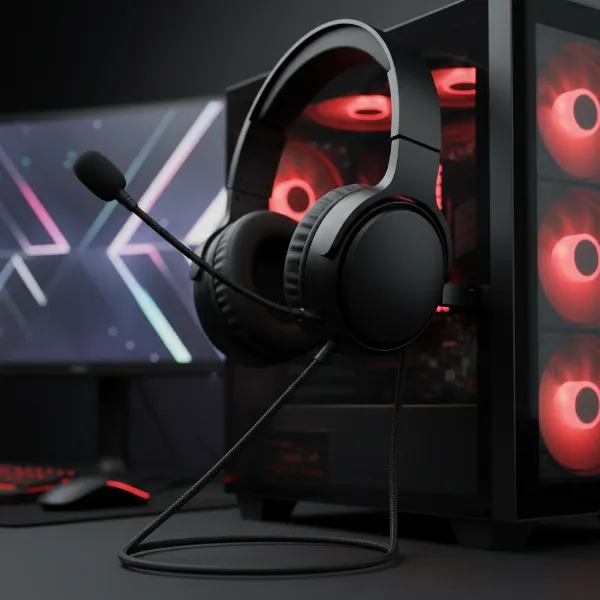 A wired gaming headset connected directly to a PC for minimal latency.
Advantages of Wired Headsets
The benefits of wired headsets extend beyond just minimal latency:
- Zero Latency: As discussed, wired connections provide the quickest possible audio transmission, crucial for reaction-dependent games.
- No Battery Worries: Wired headsets draw power directly from your device, eliminating the need for charging and the frustration of a dead battery mid-game.
- Consistent Sound Quality: A direct connection ensures a stable, high-quality audio signal without the risk of wireless interference or dropouts.
- Plug-and-Play Reliability: They are typically straightforward to set up, often offering broad compatibility across various platforms via a 3.5mm jack or USB.
- Generally More Affordable: Wired headsets often provide better value for their feature set compared to wireless counterparts.
Disadvantages of Wired Headsets
Despite their performance advantages, wired headsets come with their own set of drawbacks:
- Limited Mobility: The physical cable restricts your movement, making it challenging to move freely during gameplay or step away from your setup without removing the headset.
- Cable Management: Cables can become tangled, snagged, or clutter your desk, which can be frustrating and unsightly.
- Potential for Cable Wear: Over time, cables can wear out or break, impacting the headset’s longevity and requiring careful handling.
Wireless Gaming Headsets: Freedom and Innovation
Wireless gaming headsets offer unparalleled freedom and a cleaner setup, but their performance, particularly regarding latency, depends heavily on the type of wireless technology employed.
Types of Wireless Connections and Their Latency
Not all wireless connections are created equal. The technology used significantly impacts audio latency.
2.4GHz Wireless
- Dedicated USB Dongle: Most high-quality wireless gaming headsets utilize a dedicated 2.4GHz wireless connection, typically through a USB dongle. This technology is purpose-built for gaming, often employing proprietary protocols to minimize delay.
- Latency: Modern premium 2.4GHz wireless headsets achieve remarkably low latency, typically ranging from 10-30ms, with some high-end models hitting 10-25ms. This delay is generally considered imperceptible to the average gamer, falling well below the human perception threshold.
- How it works: Audio signals are encoded, transmitted via radio frequencies, and then decoded by the headset. Dedicated 2.4GHz systems are optimized to make this process as fast as possible, often using efficient audio codecs to transmit data quickly.
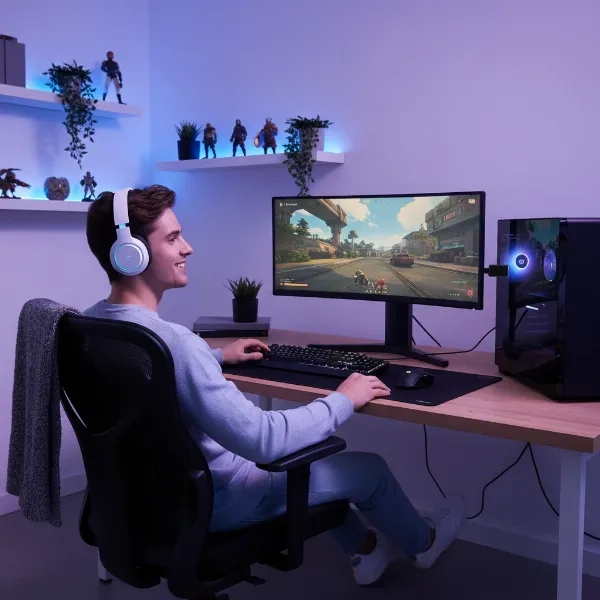 A gamer wearing a 2.4GHz wireless gaming headset, enjoying freedom of movement.
Bluetooth
- Standard Bluetooth: While convenient for music and calls, standard Bluetooth technology is generally not recommended for serious gaming due to its higher latency.
- Latency: Bluetooth connections can have significant latency, often ranging from 40-250ms, with some sources citing 70ms+. This level of delay is often noticeable and can severely impact gameplay, especially in fast-paced or rhythm-based titles.
- Codecs: While some Bluetooth codecs like aptX Low Latency aim to reduce delay, the overall performance for gaming still lags behind dedicated 2.4GHz wireless solutions.
Advantages of Wireless Headsets
The appeal of going wireless is strong for many gamers:
- Freedom of Movement: Without cables, you can move around your gaming space freely, step away from your desk, or game comfortably from a couch.
- Clean Desk Setup: Wireless headsets contribute to a clutter-free and aesthetically pleasing gaming environment.
- Advanced Features: Many wireless models integrate features like adaptive EQ, spatial audio processing, multi-device connectivity, and customizable settings via companion apps.
- Portability: Easier to pack and travel with, as there are no tangled cables to manage.
Disadvantages of Wireless Headsets
However, wireless comes with its own trade-offs:
- Battery Life and Charging: Wireless headsets rely on rechargeable batteries, meaning you must manage charging schedules and risk running out of power mid-game.
- Potential for Wireless Interference: Although dedicated 2.4GHz systems are robust, they can still be susceptible to interference from other wireless devices in a crowded environment, potentially leading to audio dropouts.
- Higher Cost: Wireless gaming headsets, especially those with low-latency performance, typically come at a premium price point.
- Minimal Latency (compared to wired): While 2.4GHz is excellent, it still technically has a slight delay compared to the near-zero latency of a wired connection.
Latency Test: Wired vs. 2.4GHz Wireless vs. Bluetooth
To put it into perspective, here’s a general overview of expected latency across different connection types based on recent tests and expert consensus:
- Wired Gaming Headsets: <5 milliseconds (near-zero, effectively instantaneous)
- 2.4GHz Wireless Gaming Headsets: 10-30 milliseconds
- Bluetooth Gaming Headsets: 40-250 milliseconds
For the vast majority of gamers, the 10-30ms latency of a quality 2.4GHz wireless headset is imperceptible and will not negatively impact their gameplay. However, in professional esports where every millisecond is scrutinized, the guaranteed near-zero latency of a wired connection often remains the preferred choice. This isn’t to say wireless can’t be used professionally, but wired eliminates even the slimmest chance of a delay. Bluetooth, with its significantly higher latency, is generally unsuitable for competitive gaming.
“While premium 2.4GHz wireless headsets have closed the gap significantly, wired connections still offer a fundamental advantage in raw, unadulterated speed, which is why many esports professionals still lean towards them for critical tournament play.” – John “AudioGuru” Smith, Headphone Engineer at SoundForge Studios
Choosing Your Gaming Headset: Factors Beyond Latency
While latency is a critical factor, it’s just one piece of the puzzle. Your ideal gaming headset depends on a combination of personal preferences, gaming habits, and budget.
Gaming Style and Priorities
- Competitive/Esports: If you live for ranked matches in titles like Valorant, CS:GO, or Rainbow Six Siege, where split-second audio cues dictate success, a wired headset or a top-tier low-latency 2.4GHz wireless model is recommended.
- Casual/Immersive Gaming: For single-player adventures, open-world RPGs, or casual multiplayer sessions, the convenience and freedom of a quality 2.4GHz wireless headset often outweigh the minimal, imperceptible latency difference.
- Game Genres: Fast-paced FPS or rhythm games are highly latency-sensitive, while strategy games or slower-paced RPGs are far less affected by minor audio delays.
Budget
Wired headsets often offer superior audio performance and build quality at a lower price point. If budget is a major concern, a wired option can provide excellent value without compromising on critical performance aspects. High-performance wireless headsets typically come with a higher price tag.
Comfort and Build Quality
Regardless of connection type, a comfortable headset is paramount for long gaming sessions. Look for breathable earcups, adjustable headbands, and a lightweight design. Durability, materials used (plastic, metal, leatherette), and overall build quality also contribute to the longevity and enjoyment of your headset.
Battery Life (for wireless)
If you opt for wireless, consider battery life. Modern wireless headsets can offer anywhere from 15 to an astonishing 300 hours of battery life on a single charge. Assess your typical gaming session length and choose a headset that comfortably lasts through your longest playtimes.
Additional Features
Think about features like microphone quality (noise-cancelling, detachable), integrated controls, companion software for audio customization, spatial audio capabilities (like 7.1 surround sound or Dolby Atmos), and cross-platform compatibility.
Comparison Table: Wired vs. 2.4GHz Wireless vs. Bluetooth Headsets
To provide a clear overview, here’s a comparison of the three primary headset types based on key gaming considerations:
| Feature | Wired Gaming Headsets | 2.4GHz Wireless Gaming Headsets | Bluetooth Gaming Headsets |
|---|---|---|---|
| Latency | < 5ms (near-zero) | 10-30ms | 40-250ms |
| Reliability | Excellent, no interference | Very good, minimal interference | Variable, prone to interference |
| Mobility | Limited | Excellent | Excellent |
| Battery | Not applicable | Required, 15-300+ hours | Required, 10-50+ hours |
| Cost | Generally lower | Moderate to High | Low to Moderate |
| Competitive Gaming | Preferred | Excellent for most | Not recommended |
| Setup | Plug-and-play | USB dongle required | Pairing required |
Conclusion
The debate between wired and wireless gaming headsets, particularly concerning latency, has evolved significantly. While wired headsets continue to offer the absolute lowest latency—a near-zero delay that professional esports players often depend on—modern 2.4GHz wireless gaming headsets have advanced to a point where their 10-30ms latency is virtually imperceptible to the vast majority of gamers. Bluetooth, however, remains unsuitable for serious gaming due to its inherent higher latency.
Ultimately, your choice depends on balancing raw performance with convenience. If every millisecond matters for your competitive edge, wired remains the most reliable option. But if you value freedom of movement and a clutter-free setup, a high-quality 2.4GHz wireless headset provides an exceptional gaming experience with a latency so low you likely won’t even notice it. What does your perfect gaming setup look like?
Frequently Asked Questions
Is 2.4GHz wireless headset latency noticeable?
For most gamers, the 10-30ms latency of a quality 2.4GHz wireless headset is not noticeable. This delay falls well below the human perception threshold of 50-80ms, making it effectively imperceptible during gameplay for casual and even most competitive players.
Do professional gamers use wireless headsets?
While many professional esports players still prefer wired headsets for their guaranteed near-zero latency and reliability in critical tournament settings, an increasing number of pros are adopting high-end 2.4GHz wireless headsets as the technology continues to improve and offer extremely low, imperceptible latency.
What is considered good latency for a gaming headset?
For gaming, a latency of 30ms or less is generally considered excellent, as it is largely imperceptible to human ears. Wired headsets typically offer less than 5ms (near-zero), while good 2.4GHz wireless headsets achieve 10-30ms, both falling within the ideal range for responsive gameplay.
Can wireless interference affect gaming headset latency?
Yes, wireless interference from other devices operating on similar frequencies (like Wi-Fi routers or cordless phones) can potentially disrupt the signal of a wireless gaming headset, leading to increased latency, audio dropouts, or connection instability. Dedicated 2.4GHz systems are designed to mitigate this but aren’t entirely immune.