For over two decades, the Sennheiser HD 600 has quietly held its ground as a benchmark in the world of high-fidelity audio. In an industry constantly chasing the next big thing, these open-back headphones have achieved a rare feat: timelessness. Revered by audiophiles, mastering engineers, and music lovers alike, the HD 600 embodies a philosophy of neutrality and sonic honesty that continues to captivate. This review will delve into what makes these headphones an enduring classic, exploring their sound signature, comfort, build quality, and ultimate value in today’s competitive market.
The Genesis of a Legend: Understanding the HD 600’s Legacy
Introduced in 1997, the Sennheiser HD 600 built upon the foundation laid by its predecessor, the HD 580, establishing a legacy that few audio products ever achieve. Sennheiser’s design philosophy for the HD 600 was clear: create a headphone that reproduces sound with utmost accuracy and minimal coloration. This commitment to neutrality made it an instant favorite for critical listening, mixing, and mastering, where an unvarnished truth about the audio is paramount. The open-back design is fundamental to its character, allowing air to move freely through the earcups. This prevents pressure buildup and contributes significantly to a more natural, expansive, and less fatiguing listening experience compared to closed-back alternatives. This design choice is a cornerstone of its “reference” status, intended to let the music breathe as if you’re listening to high-quality speakers in a well-treated room.
A Deep Dive into Sonic Performance
The true heart of the Sennheiser HD 600 lies in its sound, a signature that prioritizes balance and detail over overt coloration. It’s often described as a window into your music, designed to reveal every nuance without adding its own sonic flavor. Many listeners find this approach refreshing, allowing them to connect with their favorite tracks on a deeper, more analytical level. The HD 600’s ability to render complex musical passages with “laser-like precision” in instrument separation is a testament to its exceptional engineering, making it a joy for discerning ears.
Unrivaled Midrange Clarity
|
Our Picks for the Best headphone in 2026
As an Amazon Associate I earn from qualifying purchases.
|
||
| Num | Product | Action |
|---|---|---|
| 1 | BERIBES Bluetooth Headphones Over Ear, 65H Playtime and 6 EQ Music Modes Wireless Headphones with Microphone, HiFi Stereo Foldable Lightweight Headset, Deep Bass for Home Office Cellphone PC Ect. |

|
| 2 | Hybrid Active Noise Cancelling Bluetooth 6.0 Headphones 120H Playtime 6 ENC Clear Call Mic, Over Ear Headphones Wireless with Hi-Res Audio Comfort Earcup Low Latency ANC Headphone for Travel Workout |
|
| 3 | Soundcore by Anker Q20i Hybrid Active Noise Cancelling Headphones, Wireless Over-Ear Bluetooth, 40H Long ANC Playtime, Hi-Res Audio, Big Bass, Customize via an App, Transparency Mode |
|
| 4 | JBL Tune 770NC - Adaptive Noise Cancelling with Smart Ambient Wireless Over-Ear Headphones, Bluetooth 5.3, Up to 70H Battery Life with Speed Charge, Lightweight, Comfortable & Foldable Design (Black) |
|
| 5 | Sony WH-CH720N Noise Canceling Wireless Headphones Bluetooth Over The Ear Headset with Microphone and Alexa Built-in, Black New |
|
| 6 | Soundcore by Anker Q20i Hybrid Active Noise Cancelling Headphones, Wireless Over-Ear Bluetooth, 40H Long ANC Playtime, Hi-Res Audio, Big Bass, Customize via an App, Transparency Mode (White) |
|
| 7 | Sony WH-CH520 Wireless Headphones Bluetooth On-Ear Headset with Microphone and up to 50 Hours Battery Life with Quick Charging, Blue |
|
| 8 | TAGRY Hybrid Active Noise Cancelling Bluetooth Headphones 100H Playtime Wireless Over Ear Headphone with Fast Charging Hi-Res Audio Headsets Comfort Earcups for Commute Travel Office Phone PC Black |
|
| 9 | Logitech H390 Wired Headphones with Mic, USB-A Headset with Microphone for PC, Noise Cancelling Microphone for Video Meetings, Music, Gaming - Black |
|
| 10 | Sony WH-CH520 Wireless Headphones Bluetooth On-Ear Headset with Microphone and up to 50 Hours Battery Life with Quick Charging, Black |
|
If there’s one aspect of the HD 600 that consistently earns universal praise, it’s the midrange. Often described as “legendary clarity and warmth,” vocals and acoustic instruments truly shine through these headphones. The HD 600 renders voices with an almost tangible presence, making them sound incredibly natural and lifelike. This engaging and slightly forward midrange ensures that the core of most musical compositions—where melodies and harmonies primarily reside—is presented with remarkable transparency. While this forwardness can occasionally make poorly recorded tracks sound a bit “shouty” around the 3kHz region, it ultimately reinforces the headphone’s reputation as one of the most uncolored and flat-sounding options available, prized for its ability to lay bare the recording itself.
Tight, Articulate Bass
The bass response of the Sennheiser HD 600 is characterized by its tightness, cleanliness, and articulation. It’s present and accounted for, delivering a satisfying thump when the music calls for it, but never crosses into boomy or exaggerated territory. There’s a subtle mid-bass bump around 100Hz that provides a solid foundation, followed by a gentle roll-off below 40-80Hz. This means that while it offers enough low-end information for most genres, it might not satisfy avid “bass-heads” who crave overwhelming sub-bass impact. For those involved in mixing or critical listening, however, this accurate and controlled bass profile is highly desirable, offering an honest representation without masking other frequencies.
Smooth, Extended Treble
The treble of the HD 600 is meticulously well-calibrated, offering an extended response that is “devoid of sibilances” and harsh peaks. This smooth and refined high-end contributes significantly to the headphone’s non-fatiguing nature, allowing for hours of comfortable listening. Over the years, some discussions have circulated about a perceived “Sennheiser veil”—a slight lack of “zip and sparkle” or “air and harmonic content” compared to brighter, more aggressively tuned headphones. However, many audiophiles now consider this a myth, appreciating the HD 600’s gentle treble presentation which, while not overtly flashy, retains ample detail and avoids the listener fatigue often associated with overly sharp highs.
Intimate Soundstage and Precise Imaging
The soundstage of the HD 600 is often described as intimate rather than expansive. It won’t present music as if it’s coming from far beyond your head, but what it does offer is a highly accurate and precise representation of space. “Laser-like precision” in instrument separation allows you to easily pinpoint the location of individual instruments and vocalists within the mix. This excellent imaging and depth create a coherent and believable sonic environment, making it an outstanding tool for analyzing mixes or simply immersing yourself in the intricate layers of a well-produced track.
Designed for Comfort and Durability
Beyond its sonic prowess, the Sennheiser HD 600 has earned a stellar reputation for its practical design: exceptional comfort and robust durability. These headphones are built not just to sound good, but to last for years of dedicated use.
All-Day Listening Comfort
Comfort is paramount for extended listening sessions, and the HD 600 excels in this regard. The headphones are lauded for their “exceptional comfort,” featuring plush, breathable velour ear pads that gently cup the ear without causing irritation. The oval shape of the earcups accommodates most ear sizes comfortably. Weighing in at a modest 260-270 grams, the HD 600 is remarkably lightweight, with its weight evenly distributed across the headband. While the initial clamping force might feel a bit firm, it typically loosens over time, eventually becoming “just right” and allowing listeners to virtually forget they are wearing headphones, even after several hours of continuous use.
Robust and Repairable Build
The build quality of the Sennheiser HD 600 is a testament to its German engineering. Predominantly constructed from high-quality plastic, it integrates metal reinforcements in crucial areas like the headband and grilles. This combination makes the headphones “deceptively robust,” capable of withstanding years of daily handling and even minor mishaps. One of its most commendable features is its modular design; almost every component, from the ear pads and cable to the grilles and headband, is easily replaceable. This repairability significantly extends the product’s lifespan, cementing its status as a long-term investment for serious listeners and ensuring it can endure for decades with proper care and maintenance.
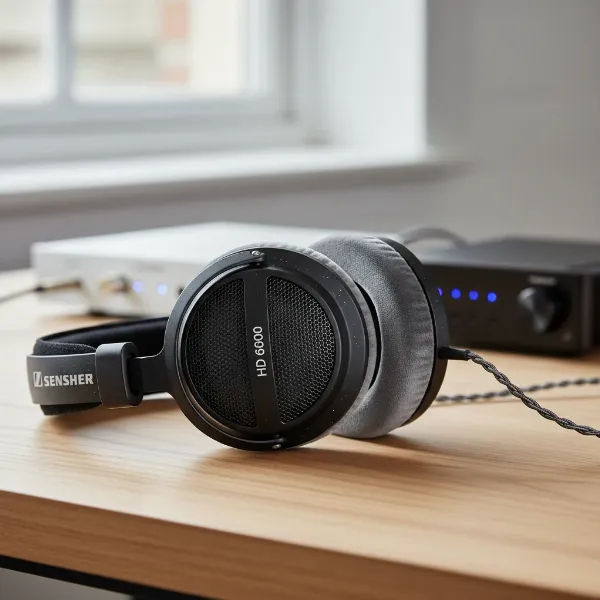 Sennheiser HD 600 open-back audiophile headphones on a desk with a DAC/amp setup, showcasing its classic design and premium materials for a review article.
Powering the HD 600: The Role of Amplification
A key characteristic of the Sennheiser HD 600 is its high impedance, rated at 300 Ohms. This technical specification directly influences its power requirements. To truly unlock the headphone’s full potential—achieving optimal volume, dynamics, and the nuanced detail it’s capable of—a dedicated headphone amplifier is essential. While the HD 600 will produce sound when plugged directly into a smartphone or laptop, the experience will often be underwhelming, characterized by lower volume and a somewhat “dull” or “loose” sound lacking in dynamic impact. Fortunately, the HD 600 is not particularly picky about the amplifier it’s paired with, often scaling beautifully even with entry-level audiophile setups, making it a gateway to exploring the world of headphone amplification.
Who is the Sennheiser HD 600 For?
The Sennheiser HD 600, with its specific strengths and characteristics, appeals to a particular kind of listener.
Ideal Users:
- Audiophiles seeking neutrality: Those who prioritize an uncolored, honest representation of their music.
- Critical listeners and engineers: Perfect for mixing, mastering, or simply dissecting a track with precision.
- Classical, jazz, acoustic, and vocal music lovers: These genres particularly benefit from the HD 600’s legendary midrange and clear articulation.
- Listeners in quiet environments: The open-back design allows sound to leak in and out, making it unsuitable for noisy places or shared spaces where silence is needed.
Less Ideal Users:
- Hardcore bass-heads: While the bass is articulate, it won’t satisfy those craving booming, exaggerated low-end.
- Competitive gamers: The intimate soundstage is not ideal for pinpointing enemies in competitive gaming scenarios.
- Listeners on the go: Its open-back nature, need for an amplifier, and relatively large size make it impractical for portable use.
The HD 600 in Today’s Market: Enduring Value
Despite being a design from the late 20th century, the Sennheiser HD 600 remains remarkably relevant and highly recommended in today’s fast-paced audio market. Its enduring performance and classic sound signature continue to hold their own against many newer, often more expensive, competitors. What makes it particularly appealing today is its exceptional value proposition. For serious music listeners looking to invest in a high-fidelity experience without breaking the bank, the HD 600 offers an unparalleled combination of sonic accuracy, comfort, and build quality. While alternatives like the Drop + Sennheiser HD 6XX offer a similar sound profile at an even more budget-friendly price point, the original HD 600 maintains its status as the definitive audiophile standard, a testament to its timeless design and unwavering quality.
Conclusion
The Sennheiser HD 600 is more than just a pair of headphones; it is a declaration of intent. It stands as a pillar of neutrality, a beacon for those who seek to hear their music exactly as the artists and engineers intended. Its legendary midrange, articulate bass, smooth treble, and precise imaging combine with exceptional comfort and a durable, repairable build to create a truly remarkable listening tool. Requiring proper amplification to truly sing, the HD 600 rewards listeners with an intimate and revealing sonic experience. If you value accuracy over excitement and crave a deep connection with your music, the HD 600 is not just a recommendation—it’s an invitation to rediscover your entire music library.
Despite its age, does the Sennheiser HD 600 remain your ultimate reference for pure sound?
Frequently Asked Questions
Do Sennheiser HD 600 headphones require an amplifier?
Yes, due to their 300-Ohm impedance, the Sennheiser HD 600 headphones generally require a dedicated headphone amplifier to achieve optimal volume, dynamics, and overall sound quality. While they will produce sound from portable devices, an amplifier unlocks their full potential, providing a richer, more detailed listening experience that highlights their nuanced sound signature.
What music genres are best suited for the Sennheiser HD 600?
The Sennheiser HD 600 excels across a wide array of genres, particularly those that benefit from its neutral and natural sound signature. It is highly recommended for classical, jazz, folk, acoustic, and vocal-centric music due to its exceptional midrange clarity. Its accurate bass and clear presentation also make it a strong performer for rock, pop, and various electronic genres, though extreme bass-heavy tracks might feel less impactful to some listeners.
Are the Sennheiser HD 600 comfortable for long listening sessions?
Absolutely. The Sennheiser HD 600 headphones are renowned for their exceptional comfort, making them ideal for extended listening sessions. They feature soft, breathable velour ear pads and a lightweight design (around 260-270g) with balanced weight distribution. While the clamping force might feel a bit firm initially, it typically loosens over time, allowing for hours of fatigue-free enjoyment, often making you forget you’re wearing them.
What is the “Sennheiser veil” often discussed in relation to the HD 600?
The “Sennheiser veil” refers to a perception by some listeners that the HD 600’s treble response might be slightly subdued or lack a certain “sparkle” or “air” compared to brighter headphones. However, many audiophiles now consider this a myth, appreciating the HD 600’s smooth, non-fatiguing treble that avoids sibilance and harshness, contributing to its natural and balanced sound profile for a more relaxed, yet detailed, listening experience.
Is the Sennheiser HD 600 still a good purchase in 2026?
Yes, despite being a design from 1997, the Sennheiser HD 600 remains an outstanding purchase in 2026 and continues to be an audiophile standard. Its timeless neutral sound, exceptional comfort, and durable, repairable build quality ensure it holds its own against many newer and often more expensive competitors. It offers remarkable value for serious music listeners seeking a true reference headphone.