Choosing the perfect pair of headphones can be a daunting task, with countless models and technical specifications to consider. At the core of every great listening experience lies the driver technology – the component responsible for converting electrical signals into the sound you hear. While many types exist, two prominent technologies dominate the high-fidelity landscape: dynamic and planar magnetic drivers. Understanding their fundamental differences is key to unlocking the right sound profile for your personal preferences. Whether you’re an audiophile chasing ultimate accuracy or a casual listener seeking reliable performance, delving into these driver types will empower you to make an informed decision.
Understanding Headphone Drivers: The Heart of Your Sound
Headphone drivers are essentially miniature loudspeakers, engineered to reproduce sound with precision. Each driver type employs a distinct method to achieve this, leading to unique sonic characteristics and performance tradeoffs.
Dynamic Drivers: The Ubiquitous Choice
|
Our Picks for the Best headphone in 2026
As an Amazon Associate I earn from qualifying purchases.
|
||
| Num | Product | Action |
|---|---|---|
| 1 | Soundcore by Anker Q20i Hybrid Active Noise Cancelling Headphones, Wireless Over-Ear Bluetooth, 40H Long ANC Playtime, Hi-Res Audio, Big Bass, Customize via an App, Transparency Mode |

|
| 2 | Hybrid Active Noise Cancelling Bluetooth 6.0 Headphones 120H Playtime 6 ENC Clear Call Mic, Over Ear Headphones Wireless with Hi-Res Audio Comfort Earcup Low Latency ANC Headphone for Travel Workout |
|
| 3 | Soundcore by Anker Q20i Hybrid Active Noise Cancelling Headphones, Wireless Over-Ear Bluetooth, 40H Long ANC Playtime, Hi-Res Audio, Big Bass, Customize via an App, Transparency Mode (White) |
|
| 4 | Sony WH-CH520 Wireless Headphones Bluetooth On-Ear Headset with Microphone and up to 50 Hours Battery Life with Quick Charging, Blue |
|
| 5 | TAGRY Hybrid Active Noise Cancelling Bluetooth Headphones 100H Playtime Wireless Over Ear Headphone with Fast Charging Hi-Res Audio Headsets Comfort Earcups for Commute Travel Office Phone PC Black |
|
| 6 | JBL Tune 770NC - Adaptive Noise Cancelling with Smart Ambient Wireless Over-Ear Headphones, Bluetooth 5.3, Up to 70H Battery Life with Speed Charge, Lightweight, Comfortable & Foldable Design (Black) |
|
| 7 | BERIBES Bluetooth Headphones Over Ear, 65H Playtime and 6 EQ Music Modes Wireless Headphones with Microphone, HiFi Stereo Foldable Lightweight Headset, Deep Bass for Home Office Cellphone PC Ect. |
|
| 8 | Sony WH-CH720N Noise Canceling Wireless Headphones Bluetooth Over The Ear Headset with Microphone and Alexa Built-in, Black New |
|
| 9 | Sony WH-CH520 Wireless Headphones Bluetooth On-Ear Headset with Microphone and up to 50 Hours Battery Life with Quick Charging, Black |
|
| 10 | Logitech H390 Wired Headphones with Mic, USB-A Headset with Microphone for PC, Noise Cancelling Microphone for Video Meetings, Music, Gaming - Black |
|
Dynamic drivers are the most common and widely used type of headphone driver, found in everything from budget earbuds to high-end over-ear models. Their widespread adoption is due to their relatively simple construction, cost-effectiveness, and versatility.
How They Work: A dynamic driver consists of three main components: a permanent magnet, a voice coil, and a diaphragm. When an electrical audio signal passes through the voice coil, it creates an electromagnetic field that interacts with the permanent magnet. This interaction causes the voice coil to move, which in turn vibrates the attached diaphragm. These vibrations generate sound waves that travel to your ears.
Pros and Cons: Dynamic drivers are known for their strong bass response and efficiency, meaning they can achieve satisfactory volume levels without requiring a dedicated amplifier. They are generally lighter, more compact, and more affordable to produce. However, at higher volumes, dynamic drivers can sometimes exhibit higher levels of harmonic distortion due to the non-uniform movement of the diaphragm, especially if not well-tuned.
Ideal for: Dynamic headphones are an excellent choice for everyday listening, casual music enjoyment, and users who prioritize portability and affordability. Their ease of driving makes them compatible with most smartphones and portable devices without additional gear.
Planar Magnetic Drivers: The Audiophile’s Precision Tool
Planar magnetic drivers, while less common than dynamic drivers, have gained significant popularity among audiophiles and audio professionals for their distinct sonic advantages. They represent a more specialized and often premium approach to headphone design.
How They Work: Unlike dynamic drivers, planar magnetic drivers utilize a thin, flat diaphragm embedded with a conductive trace. This diaphragm is suspended within a magnetic field created by an array of magnets positioned on one or both sides. When the audio signal passes through the conductor traces on the diaphragm, the entire surface is uniformly driven by the magnetic field. This uniform movement is a key differentiator from dynamic drivers.
Pros and Cons: Planar magnetic drivers excel in delivering a fast transient response, which translates to exceptional clarity, detail, and a tight, articulate bass. Their uniform diaphragm movement results in significantly lower harmonic distortion, even at higher volumes. However, planar magnetic headphones are typically heavier and larger due to the extensive magnet arrays. They are also often less efficient, usually requiring a dedicated headphone amplifier to reach their full potential, which adds to the overall cost and reduces portability.
Ideal for: Planar magnetic headphones are highly favored by critical listeners, audio engineers, and audiophiles who demand extreme accuracy, detailed soundstaging, and a neutral, uncolored sound reproduction. They are best suited for home listening setups where power and size are less of a concern.
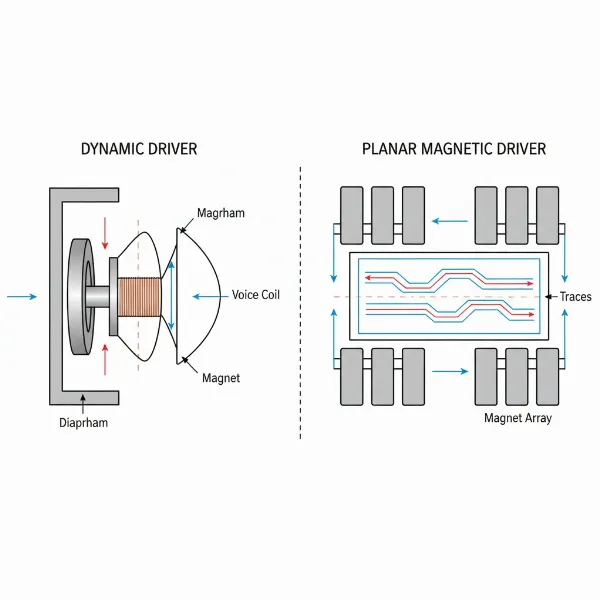 A visual comparison illustrating the internal mechanisms of dynamic and planar magnetic headphone drivers, highlighting their differences in diaphragm and magnet placement.
Key Differences: A Side-by-Side Comparison
To further clarify the distinctions, let’s look at a direct comparison of dynamic and planar magnetic headphone drivers across several key attributes.
| Feature | Dynamic Drivers | Planar Magnetic Drivers |
|---|---|---|
| Mechanism | Moving voice coil attached to a conical diaphragm | Flat diaphragm with embedded conductors suspended between magnets |
| Diaphragm Motion | Centralized, can lead to uneven movement | Uniform across the entire surface |
| Sound Clarity | Good, but can have higher distortion at extremes | Excellent, very low distortion, precise detail |
| Bass Response | Often powerful and impactful, can be boomy if not tuned well | Tight, articulate, extended, and controlled |
| Transient Response | Good | Faster and more accurate |
| Power Needs | Highly efficient, often no amplifier needed | Less efficient, usually requires a dedicated amplifier |
| Weight & Size | Generally lighter and more compact | Typically heavier and larger |
| Price Range | Available across all price points, often more affordable | Generally mid-to-high end, more expensive |
| Portability | More portable | Less portable |
Beyond the Driver: What Truly Matters for Sound Quality
While driver technology is fundamental, it’s crucial to understand that it’s just one piece of the puzzle when it comes to overall headphone performance. A well-designed headphone with dynamic drivers can easily outperform a poorly implemented planar magnetic design.
> “The best headphones are a symphony of engineering, where the driver type is merely one instrument. Tuning, acoustics, materials, and overall craftsmanship play an equally vital role in the final sound signature.”
Key factors that influence sound quality beyond the driver include:
- Manufacturer Tuning and Precision: The way a manufacturer designs and tunes the acoustics of a headphone has a monumental impact. This includes the internal dampening, earcup design, and diaphragm materials.
- Build Quality and Materials: High-quality materials and robust construction contribute not only to durability but also to sonic performance by minimizing unwanted resonances and improving comfort.
- Overall Headphone Design: Factors like open-back versus closed-back design significantly alter the soundstage, bass response, and isolation. Earpad materials and clamp force also affect both comfort and acoustic seal.
- Source Equipment: The audio source (e.g., smartphone, dedicated DAC, amplifier) plays a critical role. A high-quality amplifier can bring out the best in power-hungry headphones, especially planar magnetics.
Choosing Your Ideal Headphone Driver: A Buying Guide
Deciding between dynamic and planar magnetic headphones ultimately comes down to your personal priorities, listening habits, and budget.
Determine Your Usage Needs and Preferences
What will you primarily use your headphones for? If you need a versatile, portable option for commuting or general listening, a dynamic headphone might be more practical. For dedicated, critical listening sessions at home, where every nuance matters, a planar magnetic headphone could be a superior choice. Consider your preferred music genres; while both can handle all genres, some listeners feel planar magnetics excel in complex orchestral pieces or tracks demanding intricate detail.
Consider Your Budget
Dynamic headphones are available across a vast price spectrum, offering excellent performance even at entry-level prices. Planar magnetics, due to their more complex manufacturing and components, typically start at a higher price point and can reach into the thousands. Determine how much you are willing to invest in your audio experience.
Assess Your Existing Equipment
Do you already own a dedicated headphone amplifier? If not, and you’re considering planar magnetics, factor in the additional cost and space for an amplifier. Dynamic headphones, being more efficient, often perform admirably directly from your phone or computer.
Prioritize Comfort and Portability
Planar magnetic headphones are generally heavier and bulkier, which might impact comfort during extended listening sessions or make them less suitable for on-the-go use. Dynamic headphones tend to be lighter and more compact, making them a better choice for portability and long-wearing comfort.
Read Reviews and Try Before You Buy
Research is key. Read reviews from trusted audiophile sources and, if possible, visit an audio store to audition different models. Listening to headphones with your own music is the best way to determine which driver type and specific model resonates with your ears.
Conclusion
Both dynamic and planar magnetic drivers offer compelling listening experiences, each with its unique set of advantages. Dynamic headphones stand out for their accessibility, efficiency, and portability, making them a fantastic all-rounder for most listeners. Planar magnetic headphones, on the other hand, offer unparalleled clarity, detail, and low distortion, catering to those who prioritize absolute sonic accuracy and have the supporting equipment.
Ultimately, the “better” driver type is subjective and depends on what you value most in your audio journey. By understanding the core technologies and considering your personal needs, you can confidently navigate the vast world of headphones and discover the perfect pair to immerse yourself in your favorite sounds. Which driver technology do you think aligns best with your ideal listening experience?
Frequently Asked Questions
Do planar magnetic headphones always need an amplifier?
While many planar magnetic headphones can produce sound directly from a smartphone or computer, they are often less efficient than dynamic headphones. To unlock their full potential in terms of volume, dynamic range, and overall sound quality, a dedicated headphone amplifier is typically recommended.
Are planar magnetic headphones better for bass?
Planar magnetic headphones are renowned for their tight, controlled, and extended bass response, offering a detailed and articulate low-end rather than an exaggerated boom. While dynamic headphones can also produce powerful bass, planar magnetics often deliver a more precise and undistorted rendition of lower frequencies.
Can dynamic headphones sound as good as planar magnetic headphones?
Yes, a high-quality, well-tuned dynamic headphone can certainly compete with and even outperform a poorly implemented planar magnetic headphone. Overall sound quality is a complex interplay of driver design, acoustic engineering, materials, and tuning, not solely dependent on the driver type.
Are planar magnetic headphones good for gaming?
Planar magnetic headphones can be excellent for gaming due to their exceptional soundstage, imaging, and clarity, which can help pinpoint in-game audio cues like footsteps or distant shots. However, their larger size, weight, and potential need for an amplifier might be considerations for some gamers.