In the dynamic world of sound, a term frequently debated among music enthusiasts is “high-resolution audio.” Promising unparalleled clarity and a listening experience closer to the artist’s original intent, it has captivated many. Yet, a significant question lingers: is high-res audio a genuine leap forward in fidelity, or merely a clever marketing tactic designed to entice consumers into upgrading their gear? This article delves into the intricacies of high-resolution audio, exploring its technical underpinnings, purported benefits, and the valid criticisms that label it as an unnecessary indulgence for most listeners. We aim to provide a balanced perspective, helping you discern if this premium audio format truly justifies the hype and investment.
What Exactly is High-Resolution Audio?
High-resolution audio refers to digital audio files with a higher sampling rate and/or bit depth than standard CD-quality audio. To truly understand its essence, it’s important to grasp these two key parameters. Sampling rate dictates how many times per second an analog audio signal is converted into a digital sample, measured in kilohertz (kHz). Bit depth, on the other hand, determines the number of bits used to represent each sample, influencing the dynamic range and resolution of the sound.
Standard CD quality is defined as 16-bit/44.1 kHz, meaning it captures 44,100 samples per second, with each sample having 16 bits of information. High-resolution audio typically goes beyond this, offering formats such as 24-bit/96 kHz or even 24-bit/192 kHz. This higher data density aims to capture more subtle details and a broader dynamic range, theoretically resulting in a richer, more immersive listening experience. Common high-res file formats include FLAC (Free Lossless Audio Codec), ALAC (Apple Lossless Audio Codec), WAV (Waveform Audio File Format), and DSD (Direct Stream Digital).
The Case for High-Res Audio: Unveiling the Benefits
Proponents of high-resolution audio champion its ability to deliver a superior listening experience, citing several compelling advantages over standard and compressed audio formats like MP3s. These benefits primarily revolve around the enhanced preservation of the original recording’s detail and dynamic range.
Enhanced Clarity and Detail
|
Our Picks for the Best headphone in 2026
As an Amazon Associate I earn from qualifying purchases.
|
||
| Num | Product | Action |
|---|---|---|
| 1 | Sony WH-CH720N Noise Canceling Wireless Headphones Bluetooth Over The Ear Headset with Microphone and Alexa Built-in, White New |

|
| 2 | Soundcore by Anker Q20i Hybrid Active Noise Cancelling Headphones, Wireless Over-Ear Bluetooth, 40H Long ANC Playtime, Hi-Res Audio, Big Bass, Customize via an App, Transparency Mode (White) |
|
| 3 | Soundcore by Anker Q20i Hybrid Active Noise Cancelling Headphones, Wireless Over-Ear Bluetooth, 40H Long ANC Playtime, Hi-Res Audio, Big Bass, Customize via an App, Transparency Mode |
|
| 4 | Amazon Basics Hybrid Active Noise Cancelling Headphones, 35 Hours Playtime with ANC on and 45 Hours with ANC Off, Wireless, Over Ear Comfortable Fit, Bluetooth, One Size, Black |
|
| 5 | Sony WH-CH720N Noise Canceling Wireless Headphones Bluetooth Over The Ear Headset with Microphone and Alexa Built-in, Black New |
|
| 6 | Sony WH-CH720N Noise Canceling Wireless Headphones Bluetooth Over The Ear Headset with Microphone, Pink |
|
| 7 | Amazon Basics On Ear Wired Computer Headset with Adjustable Microphone, 3.5mm Port or in-Line Control with USB-A Port, Foldable, Clear Sound, Small/Medium Size, Black |
|
| 8 | Soundcore by Anker Q20i Hybrid Active Noise Cancelling Headphones, Wireless Over-Ear Bluetooth, 40H Long ANC Playtime, Hi-Res Audio, Big Bass, Customize via an App, Transparency Mode |
|
| 9 | Amazon Basics Bluetooth On-Ear Headphones Wireless with Microphone, Deep Bass, 35 Hour Playtime, Foldable, Collapsible, Portable Travel Friendly, Black |
|
| 10 | Soundcore by Anker Q20i Hybrid Active Noise Cancelling Headphones, Wireless Over-Ear Bluetooth, 40H Long ANC Playtime, Hi-Res Audio, Big Bass, Customize via an App, Transparency Mode (Pink) |
|
One of the most frequently touted advantages of high-res audio is its ability to render music with exceptional clarity and fine detail. Listeners often report hearing nuances that are otherwise obscured in lower-quality formats. This can include the delicate decay of a guitar string, the subtle intricacies of a vocalist’s breath, or the distinct texture of individual drum hits. This increased resolution allows dedicated audiophiles to experience their favorite tracks with a newfound level of immersion, uncovering previously hidden elements within the soundscape.
Wider Dynamic Range
High-resolution audio typically offers a broader dynamic range compared to standard or compressed formats. Dynamic range refers to the difference between the loudest and quietest parts of a recording. With a wider dynamic range, hi-res audio can more accurately reproduce the subtle shifts in volume and intensity, allowing the listener to perceive the softest whispers and the most powerful crescendos with greater distinction. This is particularly crucial for genres like classical music and jazz, where dramatic changes in volume are integral to the emotional impact of the performance.
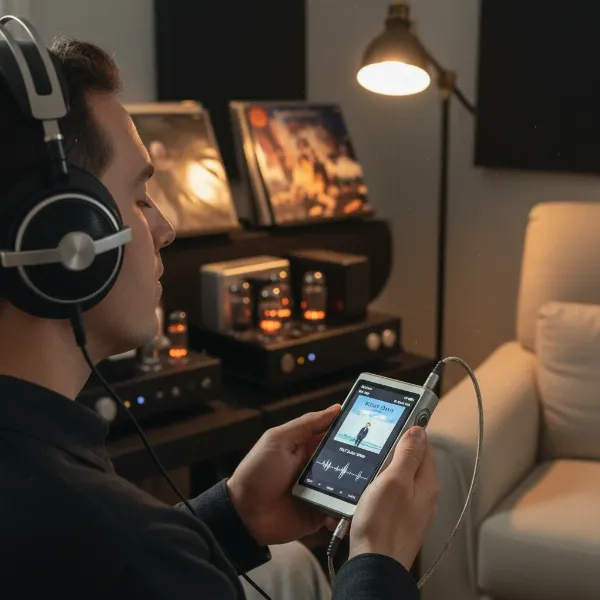 A person intently listening to music through high-quality headphones, a digital audio player displaying high-resolution audio file information, emphasizing clarity and detail in sound.
Closer to the Original Recording
The ultimate goal of many audiophiles is to hear music precisely as the artist and sound engineer intended it to sound in the studio. High-resolution audio aims to provide a more faithful reproduction of the original master recording by minimizing data loss. Unlike lossy compressed formats such as MP3, which discard certain audio information to reduce file size, hi-res formats are often uncompressed or losslessly compressed. This preservation of data means that more of the original sonic information is retained, bringing the listener closer to the master recording.
Reduced Compression Artifacts
Compressed audio formats achieve smaller file sizes by using algorithms that remove what is perceived as inaudible information. However, this process can sometimes introduce unwanted “artifacts” – subtle distortions or sonic anomalies that degrade the listening experience. High-resolution audio, especially in its uncompressed or lossless forms, avoids these compression artifacts. By preserving all or most of the original data, it delivers a cleaner, more natural sound free from the digital “noise” that can plague highly compressed files.
Is High-Res Audio a Gimmick? The Skeptical View
Despite the enthusiastic claims from audiophiles, many critics argue that high-resolution audio is largely a marketing gimmick, offering negligible, if any, audible advantages for the vast majority of listeners. These arguments are often rooted in the limitations of human hearing, the realities of audio production, and the practical demands of listening.
Human Hearing Limitations
One of the most significant counterarguments centers on human physiology. The average human ear can typically perceive frequencies up to around 20 kHz. While high-res audio formats can capture frequencies well beyond this range (e.g., up to 96 kHz), the question arises whether these extra frequencies are actually audible or contribute meaningfully to the listening experience. Furthermore, factors such as age, environmental noise, and individual ear health can further limit a person’s ability to discern subtle sonic differences, particularly at higher frequencies. Many people over the age of 40, for instance, naturally experience a decline in their ability to hear high frequencies.
The “Upsampling” Pitfall
A major criticism of the high-res audio market is the practice of “upsampling.” This occurs when standard CD-quality (or even lower-resolution) recordings are digitally converted to a higher sample rate (e.g., from 44.1 kHz to 96 kHz) and then marketed as “high-resolution.” This process, akin to taking a standard photograph and simply enlarging it, does not magically add new detail or information that wasn’t present in the original recording. In fact, upsampling can sometimes introduce digital artifacts or errors, potentially making the “high-res” file sound worse than the original, despite its larger file size and higher specifications. It’s crucial for consumers to distinguish between genuinely high-resolution recordings made with superior source material and those that are merely upsampled.
“Many controlled blind listening tests by audio engineering societies consistently find no reliable advantage for consumers perceiving commonly distributed high-resolution audio over well-mastered 16-bit/44.1kHz recordings.” – Dr. Mark Waldrep, Digital Audio Expert
The Equipment Requirement
To truly appreciate any potential benefits of high-resolution audio, a complete “hi-res ecosystem” is required. This means investing in specialized equipment, including a hi-res audio player or streaming service, a high-quality Digital-to-Analog Converter (DAC), and capable headphones or speakers that can accurately reproduce the extended frequency range and dynamic detail. For many casual listeners, their existing smartphones, standard headphones, and Bluetooth connections simply cannot process or transmit the full fidelity of hi-res audio, rendering the format essentially indistinguishable from lower-resolution alternatives. This often leads to significant additional costs for hardware that may not yield a discernible improvement for the average user.
Blind Test Findings
Several scientific studies and well-controlled blind listening tests conducted by organizations like the Audio Engineering Society have often failed to demonstrate a consistent and reliable advantage for high-resolution audio over CD-quality audio in terms of audibility for consumers. These tests typically involve participants trying to distinguish between different audio qualities without knowing which is which. The results frequently indicate that while some individuals claim to hear a difference, the ability to do so consistently and under controlled conditions is rare, leading many to conclude that any perceived difference is often subjective or placebo-driven.
File Size Concerns
High-resolution audio files are significantly larger than their compressed counterparts. A single hi-res track can be tens of megabytes, and an album can quickly consume gigabytes of storage space. While storage has become cheaper, this still presents challenges for mobile devices, streaming over limited data plans, and managing extensive music libraries. The increased file size can also lead to longer download times and higher bandwidth consumption, which might be impractical for many users.
Who Benefits Most from High-Res Audio?
Given the debate, it’s clear that high-resolution audio isn’t for everyone. However, specific groups of individuals and listening scenarios are more likely to genuinely benefit from its purported advantages.
Dedicated Audiophiles
At the forefront are dedicated audiophiles – individuals with a deep passion for sound quality who invest heavily in high-end audio equipment. These listeners possess a trained ear and often configure their listening environments to minimize interference, allowing them to critically analyze subtle sonic differences. For them, hi-res audio offers the potential for a more refined, detailed, and emotionally engaging experience, where every nuance is valued.
Critical Listeners with High-End Gear
Beyond the strict definition of an “audiophile,” there are critical listeners who appreciate high-fidelity sound and have invested in quality playback systems. This includes high-resolution digital audio players (DAPs), external DACs, powerful amplifiers, and premium headphones or speakers. With such capable equipment, these individuals are in the best position to discern the finer details and wider dynamic range that genuine high-res recordings can offer. They often listen in quiet, dedicated spaces, allowing for focused, undistracted appreciation of the audio.
Not for Casual Listeners or Wireless Users
Conversely, high-resolution audio offers minimal to no discernible benefit for casual listeners. If you primarily listen to music on your smartphone with bundled earbuds, through Bluetooth headphones, or on a basic sound system, the technical superiority of hi-res files will likely be lost. Compressed audio formats like high-bitrate MP3s or AAC (such as those used by Spotify or Apple Music’s standard streams) are more than sufficient for convenience-oriented listening. Wireless transmission protocols, even advanced ones, often compress audio, effectively negating the benefits of a high-res source.
What You Need to Experience High-Res Audio
To unlock the full potential of high-resolution audio, you need more than just the files themselves. A compatible audio chain is essential to process and reproduce the rich data without degradation.
Hi-Res Audio Files or Streaming Service
The first requirement is access to actual high-resolution audio content. This can be obtained through dedicated download stores that offer tracks in formats like FLAC, ALAC, WAV, or DSD. Alternatively, several streaming services now offer high-res tiers, including platforms like Tidal, Qobuz, Amazon Music HD, and Apple Music Lossless (which includes hi-res tiers). Ensure the source material is genuinely high-res and not simply an upsampled version of a lower-quality recording.
Compatible Playback Device (DAC, Player)
Your playback device must be capable of decoding and processing high-resolution audio files. A high-quality Digital-to-Analog Converter (DAC) is crucial, as it translates the digital information into an analog signal that your headphones or speakers can play. Many modern smartphones and computers have built-in DACs, but external, dedicated DACs often offer superior performance for hi-res playback. Standalone hi-res audio players (DAPs) are also popular among audiophiles for their dedicated processing power and higher-quality components.
Quality Headphones or Speakers
Even with the highest quality source and DAC, the final link in the chain—your headphones or speakers—must be capable of reproducing the detailed sound. Entry-level headphones or speakers may not have the frequency response or driver resolution to convey the subtle nuances of hi-res audio. Investing in high-fidelity headphones (over-ear or in-ear monitors) or a capable speaker system designed for critical listening is essential to perceive any difference offered by high-resolution audio. The transparency and accuracy of your transducers directly impact whether the improved data translates into an improved listening experience.
Conclusion
The question of whether high-resolution audio is a gimmick or a game-changer largely depends on who you ask and how they listen. For the casual listener, enjoying music on their daily commute with standard headphones, the difference is likely imperceptible, making the additional cost and storage demands unwarranted. In this context, high-res audio can indeed feel like a marketing ploy.
However, for dedicated audiophiles and critical listeners equipped with high-fidelity gear and a keen ear, high-resolution audio offers the potential for a more detailed, dynamic, and immersive experience. It allows for a deeper connection with the music, revealing layers and nuances often lost in compressed formats. The enhanced clarity, wider dynamic range, and closer fidelity to the original recording can be genuinely transformative for those who prioritize sound quality above all else.
Ultimately, the value of high-res audio is subjective. It’s not a universal upgrade, but a niche enhancement for those willing to invest in both the technology and the dedicated listening environment required to appreciate it. Before diving into the world of high-res audio, consider your personal listening habits, your current equipment, and your budget. Are you prepared to chase every last nuance, or is the convenience and excellent sound of high-quality compressed audio sufficient for your musical enjoyment?
Frequently Asked Questions
What’s the main difference between high-res audio and CD quality?
High-res audio typically features higher bit depths (e.g., 24-bit) and sampling rates (e.g., 96 kHz, 192 kHz) compared to CD quality’s 16-bit/44.1 kHz. This means high-res files contain more data, theoretically allowing for a more accurate and detailed representation of the original sound with a wider dynamic range.
Do I need special equipment to listen to high-res audio?
Yes, to fully appreciate high-res audio, you generally need compatible hardware, including a source for hi-res files (like a streaming service or downloads), a high-quality Digital-to-Analog Converter (DAC), and capable headphones or speakers. Standard consumer devices and Bluetooth connections may not be able to process or transmit the full high-res data.
Can everyone hear the difference with high-res audio?
No, not everyone can consistently hear a difference between high-res audio and CD-quality audio, especially in blind listening tests. Factors like individual hearing acuity, age, and the quality of the playback system significantly influence perceptibility. For many, particularly casual listeners, the benefits are often negligible.
Are all “high-res” files genuinely better quality?
Not necessarily. Some “high-res” files are simply upsampled versions of lower-quality recordings, meaning they’ve been converted to a higher sample rate without adding any new audio information. Genuine high-res audio originates from master recordings made at higher resolutions and is preserved throughout the production chain.
Is high-res audio worth the extra cost?
Whether high-res audio is “worth it” depends entirely on your priorities and setup. If you are a dedicated audiophile with high-end equipment and a critical ear, the investment might provide a more immersive experience. For most casual listeners, the cost and inconvenience often outweigh the unnoticeable sonic improvements.