Stepping into the world of high-fidelity audio can be both exhilarating and a little overwhelming. You’ve invested in a fantastic pair of headphones, anticipating a transformative listening experience, only to find the sound isn’t quite as dynamic or loud as you expected. This common scenario often leads music lovers to two crucial, yet frequently misunderstood, terms: headphone impedance and the need for an external amplifier. Understanding these concepts is key to unlocking the full potential of your audio gear and truly hearing music as it was meant to be heard. This guide will clarify what impedance means, how it influences your headphone’s performance, and whether adding a dedicated amplifier will elevate your sound.
What is Headphone Impedance?
At its core, headphone impedance is a measure of the opposition an electrical circuit presents to an alternating current. Think of it like a specific type of electrical “friction” or resistance within your headphones, particularly within the voice coils that convert electrical signals into the sound you hear. This opposition is measured in units called ohms (Ω). Every wired headphone has an impedance rating, typically found in its specifications, that indicates how much electrical energy is required to drive it effectively. It’s a fundamental characteristic that dictates how well your headphones will pair with different audio sources, from smartphones to professional studio equipment.
The Impact of Impedance on Your Listening Experience
The impedance of your headphones plays a pivotal role in determining their performance characteristics, influencing everything from the maximum volume they can achieve to the clarity and detail of the audio. Matching your headphone’s impedance with your audio source is crucial for optimal sound.
Low Impedance Headphones (Under 50 Ohms)
Low impedance headphones are designed to be easily driven by devices with limited power output. They typically range from 16 to 32 ohms, making them ideal companions for a wide array of portable electronics.
- Characteristics: These headphones require less voltage to reach a comfortable listening volume. They are generally more efficient, meaning they can produce louder sound with less power.
- Pros: Highly versatile for mobile use with smartphones, tablets, and laptops, which have built-in amplifiers with limited output. They are battery-friendly and often deliver a dynamic, punchy sound, especially in the lower frequencies.
- Cons: When connected to powerful amplifiers, very low impedance headphones can sometimes be more susceptible to distortion or an uncontrolled bass response if not properly matched. They might also pick up more background noise from less-than-ideal audio sources.
 Person listening to music with low impedance headphones connected to a smartphone.
High Impedance Headphones (Over 100 Ohms)
On the other end of the spectrum are high impedance headphones, often found in professional studio environments or among audiophile-grade equipment. These headphones can range from 100 ohms all the way up to 600 ohms.
- Characteristics: High impedance headphones demand significantly more voltage to achieve adequate listening levels. Their design allows them to handle higher input power without distorting, which often contributes to a more refined sound.
- Pros: They are renowned for their superior sound clarity, detailed reproduction, and a more balanced frequency response, particularly in high frequencies. They excel in environments where precise audio monitoring or critical listening is required, as they are less prone to distortion even at higher volumes.
- Cons: Due to their power requirements, high impedance headphones typically sound too quiet or lack dynamics when plugged directly into portable devices or standard computer headphone jacks. They almost always necessitate a dedicated headphone amplifier to perform at their best.
Moderate Impedance Headphones (50-100 Ohms)
Some headphones fall into a moderate impedance range, aiming for a balance between portability and sound quality. These might be around 60 or 70 ohms.
- Characteristics: These headphones offer a good balance of performance and versatility. They can often be driven to acceptable volumes by higher-quality portable devices or standard audio interfaces, but they will still benefit noticeably from a dedicated amplifier.
- Pros: They offer more detail and less distortion than many low-impedance options, while being more forgiving on power requirements than high-impedance models.
- Cons: While more versatile, they might not achieve peak performance with all mobile sources, nor will they necessarily match the ultimate fidelity of high-impedance headphones driven by a top-tier amplifier.
Do You Need a Dedicated Headphone Amplifier?
This is the million-dollar question for many audio enthusiasts. While every headphone requires some form of amplification to produce audible sound (your phone, laptop, or stereo all have tiny, built-in amps), the necessity of a dedicated external headphone amplifier depends largely on your headphones and your listening goals.
When an Amp is Essential
- High-Impedance Headphones: If your headphones have an impedance of 100 ohms or higher, a dedicated amplifier is almost always necessary. Without it, you’ll likely experience insufficient volume, a lack of dynamic range, and a generally lifeless sound. An amp provides the necessary voltage to “wake up” these headphones, allowing them to deliver their intended high-fidelity performance.
- Optimal Sound Quality: Even for some lower-impedance headphones, a high-quality external amplifier can make a significant difference. It can provide a cleaner, more powerful signal with less distortion, improved bass control, and a wider soundstage, pushing your headphones to their full potential beyond what a basic built-in amp can offer.
- Driving Specific Headphone Types: Planar magnetic headphones, for example, often require amplifiers capable of delivering substantial current rather than just high voltage, to truly shine. Similarly, sensitive in-ear monitors (IEMs) can benefit from an amp with a very low noise floor to prevent audible hiss.
- Weak Built-in Sources: Many laptops, computers, and older portable music players have notoriously weak headphone outputs. If you find your headphones sound quiet or lack punch even at maximum volume, an external amplifier can significantly improve the listening experience.
“Matching your headphones’ impedance to a capable amplifier isn’t just about volume; it’s about unlocking dynamics, clarity, and the true sonic character your headphones were engineered to deliver.” – Dr. Alistair Finch, Audio Engineering Specialist
When an Amp is Optional or Less Critical
- Low-Impedance, High-Sensitivity Headphones: Most modern consumer headphones, particularly those designed for portable use, are low impedance (under 50 ohms) and high sensitivity. They are efficient enough to be driven to satisfactory volumes by most smartphones and portable devices without an external amp.
- Noise-Cancelling Headphones: These headphones typically have their own built-in amplification system for the active noise cancellation circuitry. Adding an external amp might not provide any significant audio benefit and could even introduce unwanted noise.
- Capable Audio Interfaces: If you’re using a professional audio interface or a high-end digital audio player (DAP) with a robust headphone output, the built-in amplification might be sufficient for a wide range of headphones, even some moderately high-impedance models.
Understanding Sensitivity
Alongside impedance, headphone sensitivity (often measured in dB SPL/mW or dB SPL/V) is another crucial specification. It indicates how loud your headphones will get for a given amount of power. High-sensitivity headphones produce more volume with less power, making them easier to drive. Conversely, low-sensitivity headphones require more power to achieve the same volume. A headphone with high impedance and low sensitivity will be the most difficult to drive and will almost certainly require a dedicated amplifier.
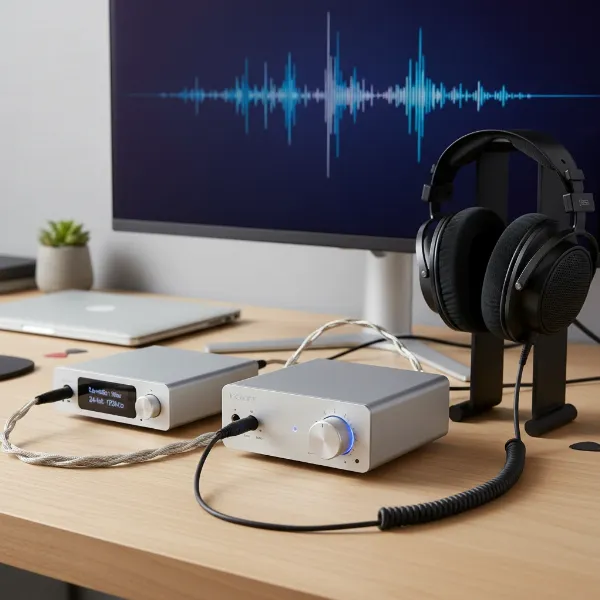 A dedicated headphone amplifier connected to a DAC with high impedance headphones.
The Science of Impedance Matching: Amplifier to Headphone
Beyond simply providing enough power, the relationship between your amplifier’s output impedance and your headphone’s impedance is critical for optimal audio fidelity. This is known as impedance matching.
The widely accepted “rule of eighths” suggests that for the best performance, the amplifier’s output impedance should be at least eight times lower than the headphone’s impedance. For instance, if you have 300-ohm headphones, your amplifier’s output impedance should ideally be 37.5 ohms or less.
Why Matching Matters:
- Efficient Power Transfer: Proper impedance matching ensures that the maximum amount of power is efficiently transferred from the amplifier to your headphones. This translates to a stronger, clearer signal.
- Damping Factor: A low amplifier output impedance relative to the headphone impedance provides a high “damping factor.” This means the amplifier has better control over the headphone drivers, preventing unwanted oscillations and improving bass tightness and overall transient response.
- Reduced Distortion: When impedance is mismatched, especially with a high amplifier output impedance, the amplifier can struggle to control the headphone’s drivers. This can lead to increased distortion, particularly at higher volumes or with complex musical passages, and an uneven frequency response. The headphone’s inherent frequency response might change, leading to coloration of the sound.
Ignoring impedance matching can result in a compromised listening experience, with muffled bass, harsh treble, and a general lack of clarity, even if your headphones are expensive.
Choosing the Right Amplifier for Your Headphones
Selecting an amplifier involves more than just plugging it in. Here’s what to consider:
1. Match Impedance and Sensitivity
Prioritize amplifiers that explicitly state compatibility with your headphone’s impedance range. For high-impedance, low-sensitivity headphones, you’ll need an amp with substantial voltage output. For sensitive, low-impedance headphones, look for an amp with a low output impedance and a low noise floor to prevent hiss.
2. Output Power (Watts/Milliwatts)
Check the amplifier’s power output specifications. For most high-impedance headphones, you’ll typically want an amp that can deliver at least 100mW (milliwatts) into a comparable load. Planar magnetics might require 1-2 watts for optimal performance. Don’t just chase raw power; ensure it’s clean power.
3. Output Impedance of the Amp
As discussed with impedance matching, aim for an amplifier with a low output impedance (ideally < 1/8th of your headphone’s impedance) for maximum control and fidelity. Many modern amps are designed with very low output impedance to cater to a wide range of headphones.
4. Sound Signature
Amplifiers come with different “sound signatures”:
- Solid-state amplifiers are often praised for their transparency, neutrality, and powerful bass.
- Tube amplifiers are known for adding a warmer, more “musical” quality to the sound, sometimes described as having a richer midrange.
- Hybrid designs attempt to combine the best aspects of both. Your preference will dictate the best choice.
5. DAC/Amp Combos
Many modern headphone amplifiers come integrated with a Digital-to-Analog Converter (DAC). A DAC converts digital audio signals (from your computer or streaming device) into an analog signal that your amplifier can then boost. A good DAC can significantly improve sound quality by bypassing the often-inferior DACs found in consumer-grade devices. For a streamlined desktop setup, a DAC/amp combo is often an excellent and space-saving solution.
Conclusion
Understanding headphone impedance and the role of an amplifier is not just for audiophiles; it’s fundamental knowledge for anyone serious about getting the best sound from their headphones. By considering your headphone’s impedance and sensitivity, and matching it with an appropriate audio source or dedicated amplifier, you can unlock a vastly improved listening experience. From robust volume levels to pristine clarity and impactful dynamics, the right amplification can transform your audio setup. So, take a moment to check your headphone’s specs and consider if a dedicated amplifier might be the missing link in your pursuit of perfect sound. What kind of sound journey are you hoping to embark on next with your perfectly matched audio gear?
Frequently Asked Questions
What is the ideal impedance for headphones?
There isn’t one “ideal” impedance; it depends on your primary listening device. For portable devices like smartphones, headphones with low impedance (16-32 ohms) are ideal. For professional studio use or high-fidelity home setups, higher impedance headphones (100-600 ohms) paired with a powerful amplifier offer superior sound quality.
Can I damage my headphones by using the wrong amplifier?
While direct damage is rare with standard use, using an underpowered amplifier with high-impedance headphones won’t damage them but will result in poor sound. Conversely, an overly powerful amp on very sensitive, low-impedance headphones could potentially cause distortion or, in extreme cases at very high volumes, damage the drivers, though most users would stop due to discomfort first.
Do wireless headphones have impedance?
Yes, wireless headphones still have an impedance rating for their drivers. However, they also contain a built-in amplifier and DAC, so they manage the impedance internally. You typically don’t need an external amplifier for wireless headphones as they are self-powered and self-amplified.
How can I tell if my headphones need an amp?
If your headphones sound quiet, lack bass, or seem lifeless when plugged directly into your phone or computer, especially at maximum volume, they likely benefit from an amplifier. This is particularly true for larger, over-ear headphones and those with impedance ratings over 100 ohms.
What is the difference between an amplifier and a DAC?
A DAC (Digital-to-Analog Converter) converts digital audio signals (like MP3s or streaming audio) into an analog electrical signal. An amplifier then takes that analog signal and boosts its power so it can drive your headphones to a listenable volume and quality. Many devices combine both functions into a single unit.
Can a DAC replace an amplifier?
No, a DAC cannot replace an amplifier. A DAC’s role is to convert digital to analog, not to increase power. While some DACs have a basic headphone output (meaning they have a very small, built-in amplifier), a dedicated amplifier is needed to provide sufficient power, especially for high-impedance or demanding headphones.