Stepping into the world of wireless audio often brings with it a surprising revelation: the sound quality you experience isn’t just about your headphones or speakers. It’s profoundly influenced by something called an “audio codec.” These unsung heroes of wireless communication quietly work in the background, compressing and decompressing your music so it can travel seamlessly from your device to your ears via Bluetooth. But with terms like LDAC, aptX, and AAC frequently appearing, how do you know which one is delivering the best experience for your personal listening habits?
This guide will demystify these popular Bluetooth audio codecs, explaining what each one brings to the table in terms of sound quality, latency, and compatibility. By understanding their strengths and weaknesses, you’ll be empowered to make informed decisions, ensuring your wireless audio setup truly matches your expectations and delivers an unparalleled listening experience.
The Importance of Audio Codecs in Wireless Audio
When you stream music over Bluetooth, your audio data needs to be packaged efficiently to travel wirelessly. This is where audio codecs come into play, acting as both a “coder” (compressing the data) and a “decoder” (uncompressing it on the receiving end). Without codecs, transmitting high-quality audio over Bluetooth’s limited bandwidth would be impractical, if not impossible. They are essential software formats that compress and encode music for efficient wireless transmission between devices.
The choice of codec can significantly impact your listening experience. Different codecs employ varying methods of compression and processing, directly affecting the bitrate – the amount of data transferred per second – and consequently, the audio fidelity, latency, and overall stability of your connection. A higher bitrate generally means more audio information is preserved, leading to a richer, more detailed sound, but it also demands more bandwidth and can be less stable in challenging environments.
Decoding Bluetooth Audio Codecs: LDAC, aptX, and AAC
While the standard SBC (Subband Codec) is universally supported by all Bluetooth devices, it often serves as a baseline, offering basic audio quality. For a truly elevated wireless sound experience, you’ll want to explore more advanced codecs like LDAC, aptX, and AAC, each designed with unique characteristics and target applications.
LDAC: Sony’s High-Resolution Solution
LDAC is a proprietary audio coding technology developed by Sony, designed specifically to transmit high-resolution audio over a Bluetooth connection. Unlike conventional Bluetooth codecs, LDAC aims to deliver approximately three times more data than SBC, supporting bitrates up to 990 kbps and audio resolutions up to 24-bit/96 kHz.
- Advantages: LDAC offers exceptional theoretical audio quality, capable of delivering detailed and nuanced sound that audiophiles often seek. It’s certified for “Hi-Res Audio Wireless,” making it a top-tier choice for those with high-resolution audio files. While initially exclusive to Sony, it has been part of the Android Open Source Project (AOSP) since Android 8.0 Oreo, meaning many Android devices now support it.
- Disadvantages: Despite its high performance, LDAC can be a “battery hog” at its highest bitrate settings, potentially draining your device’s battery faster than other codecs. Furthermore, its optimal performance often requires you to manually adjust settings in your phone’s developer options, as many devices default to lower, more stable bitrates. It can also be susceptible to interference and range limitations, leading to connection drops or quality reduction in less ideal environments.
- Ideal Use Cases: LDAC is best suited for critical listening sessions with high-resolution audio files (like FLAC or WAV) in quiet environments, where maintaining the highest possible audio fidelity is the top priority.
|
Our Picks for the Best headphone in 2026
As an Amazon Associate I earn from qualifying purchases.
|
||
| Num | Product | Action |
|---|---|---|
| 1 | Amazon Basics On Ear Wired Computer Headset with Adjustable Microphone, 3.5mm Port or in-Line Control with USB-A Port, Foldable, Clear Sound, Small/Medium Size, Black |

|
| 2 | Amazon Basics Hybrid Active Noise Cancelling Headphones, 35 Hours Playtime with ANC on and 45 Hours with ANC Off, Wireless, Over Ear Comfortable Fit, Bluetooth, One Size, Black |
|
| 3 | Soundcore by Anker Q20i Hybrid Active Noise Cancelling Headphones, Wireless Over-Ear Bluetooth, 40H Long ANC Playtime, Hi-Res Audio, Big Bass, Customize via an App, Transparency Mode (Pink) |
|
| 4 | Sony WH-CH720N Noise Canceling Wireless Headphones Bluetooth Over The Ear Headset with Microphone, Pink |
|
| 5 | Soundcore by Anker Q20i Hybrid Active Noise Cancelling Headphones, Wireless Over-Ear Bluetooth, 40H Long ANC Playtime, Hi-Res Audio, Big Bass, Customize via an App, Transparency Mode |
|
| 6 | Soundcore by Anker Q20i Hybrid Active Noise Cancelling Headphones, Wireless Over-Ear Bluetooth, 40H Long ANC Playtime, Hi-Res Audio, Big Bass, Customize via an App, Transparency Mode (White) |
|
| 7 | Amazon Basics Bluetooth On-Ear Headphones Wireless with Microphone, Deep Bass, 35 Hour Playtime, Foldable, Collapsible, Portable Travel Friendly, Black |
|
| 8 | Sony WH-CH720N Noise Canceling Wireless Headphones Bluetooth Over The Ear Headset with Microphone and Alexa Built-in, Black New |
|
| 9 | Soundcore by Anker Q20i Hybrid Active Noise Cancelling Headphones, Wireless Over-Ear Bluetooth, 40H Long ANC Playtime, Hi-Res Audio, Big Bass, Customize via an App, Transparency Mode |
|
| 10 | Sony WH-CH720N Noise Canceling Wireless Headphones Bluetooth Over The Ear Headset with Microphone and Alexa Built-in, White New |
|
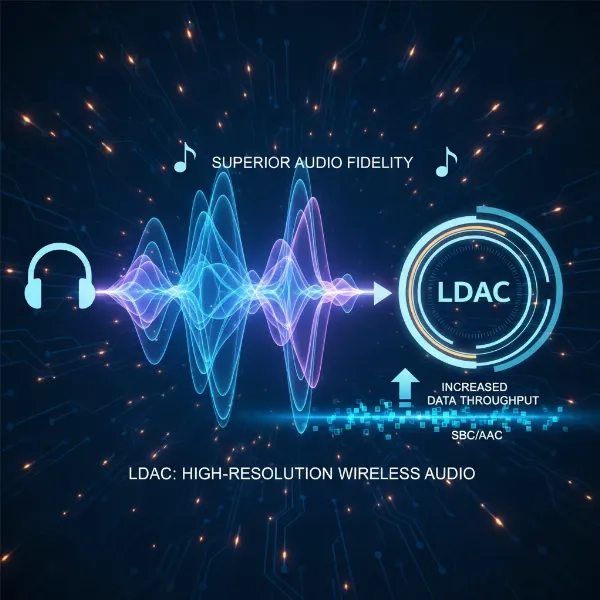 Illustration of LDAC codec transmitting high-resolution audio wirelessly, showing data flow and quality enhancement for audiophiles
aptX: Qualcomm’s Family of Codecs
aptX is a family of audio codecs developed by Qualcomm, known for providing improved sound quality and lower latency compared to SBC. This family includes several variants, each tailored for different priorities.
-
aptX (Standard): This foundational version offers a significant improvement over SBC, delivering near CD-quality sound at around 352 kbps. It strikes a good balance between audio quality and connection stability for everyday listening.
-
aptX HD: A step up from standard aptX, aptX HD supports high-resolution audio up to 24-bit/48 kHz with bitrates extending to 576 kbps. It’s designed for serious music enthusiasts who desire audio quality as close to lossless as possible.
-
aptX Low Latency (aptX LL): As its name suggests, aptX LL prioritizes minimizing audio delay, achieving latency as low as 30-40 milliseconds. This makes it crucial for applications requiring tight audio-visual synchronization, such as gaming and watching videos.
-
aptX Adaptive: Qualcomm’s more recent innovation, aptX Adaptive combines the benefits of aptX HD’s quality and aptX Low Latency’s responsiveness. It dynamically scales the bitrate (between 279 kbps and 420 kbps) in real-time, adapting to environmental radio frequency conditions to minimize drop-outs and optimize audio quality or latency depending on the content (music, calls, gaming). It also supports 24-bit/96kHz files.
-
aptX Lossless: This latest addition aims to deliver truly lossless CD-quality audio (16-bit/44.1 kHz) over Bluetooth, with potential bitrates up to 1,200 kbps. However, like other high-bitrate codecs, it can downscale to aptX Adaptive in challenging signal environments.
- Advantages: The aptX family offers a versatile range of codecs catering to various needs, from high-fidelity listening to ultra-low latency gaming. They generally provide stable connections and are widely supported across many Android devices with Qualcomm chipsets.
- Disadvantages: aptX codecs are proprietary to Qualcomm, meaning both the source device and the receiving device must support the specific aptX variant for it to work. This can limit compatibility compared to more open standards.
- Ideal Use Cases: aptX codecs are excellent all-rounders. Standard aptX is great for general Android users, aptX HD for higher quality, aptX Low Latency for gaming and video, and aptX Adaptive for a balanced experience that dynamically adjusts to your environment and content.
AAC: The Apple Standard (and Beyond)
Advanced Audio Coding (AAC) is a widely adopted, lossy digital audio compression standard that was originally developed as a successor to the MP3 format. It is particularly prevalent in the Apple ecosystem, serving as the default Bluetooth codec for iPhones, iPads, and AirPods, as well as being used by major streaming services like YouTube and Spotify.
- Advantages: AAC offers efficient compression, delivering high-fidelity sound even at lower bitrates compared to older formats like MP3. It’s optimized to perform exceptionally well on Apple devices, where Apple’s hardware and software are designed to efficiently handle its processing, ensuring good sound quality without excessive battery drain. AAC also supports multiple audio channels, including stereo and surround sound, providing flexibility for various content types.
- Disadvantages: While AAC performs strongly on Apple devices, its efficiency and audio quality can vary significantly on Android devices, depending on the manufacturer’s implementation. This inconsistency means Android users might not always get the best out of AAC. It also isn’t known for particularly low latency, making it less ideal for fast-paced gaming where audio-visual synchronization is crucial.
- Ideal Use Cases: AAC is the go-to codec for anyone deeply embedded in the Apple ecosystem, offering reliable and good-quality audio for music streaming, podcasts, and general media consumption. It’s also suitable for use with streaming platforms that often encode their content in AAC.
Key Factors When Comparing Audio Codecs
Choosing the right audio codec isn’t a one-size-fits-all decision. Several factors influence how a codec performs and how it impacts your listening experience. Understanding these can help you identify which codec best suits your priorities.
Audio Quality and Bitrate
Bitrate, measured in kilobits per second (kbps), indicates the amount of data transferred per second. Generally, a higher bitrate allows for more audio information to be transmitted, leading to a richer and more detailed sound.
- LDAC: Offers the highest theoretical bitrate among these codecs, up to 990 kbps, supporting high-resolution audio (24-bit/96 kHz).
- aptX Family: Ranges from standard aptX at 352 kbps (near CD-quality) to aptX HD at 576 kbps (high-definition) and aptX Lossless potentially up to 1,200 kbps for CD-quality lossless audio. aptX Adaptive dynamically scales between 279-420 kbps.
- AAC: Typically operates around 320 kbps, providing good quality, especially on optimized platforms.
It’s important to remember that a higher bitrate doesn’t automatically guarantee superior sound. The quality of the original audio file (e.g., MP3 vs. FLAC), the quality of your headphones, and the efficiency of the codec’s compression algorithm all play a crucial role. As a Reddit user aptly put it, “Garbage in, garbage out. If your source is crap, don’t expect better sound just because your BT shifted from AAC to LDAC.”
Latency
Latency refers to the delay between an audio signal being sent from the source device and being heard through your headphones. While imperceptible for music listening, high latency can be very noticeable and frustrating for video playback (lip-sync issues) or gaming.
- aptX Low Latency: This codec is specifically engineered for minimal delay, often achieving latency as low as 30-40 ms, making it the top choice for gaming and video.
- aptX Adaptive: Also offers low latency capabilities, typically down to 80 ms, making it suitable for multimedia.
- LDAC & AAC: Can have higher latency compared to aptX Low Latency, especially when operating at their highest quality settings, making them less ideal for time-sensitive applications like gaming.
Device Compatibility and Ecosystem
For any Bluetooth audio codec to work, both the transmitting device (e.g., your smartphone) and the receiving device (e.g., your headphones) must support that specific codec. If they don’t share a common advanced codec, they will typically default to SBC.
- LDAC: Widely supported on Android devices (Android 8.0 Oreo and newer) and Sony audio products.
- aptX Family: Primarily found on Android smartphones with Qualcomm Snapdragon processors and a wide range of headphones from various manufacturers.
- AAC: The dominant codec in the Apple ecosystem (iPhones, iPads, AirPods) and supported by many Android devices, although with varying performance.
Power Consumption
Transmitting high-resolution audio at high bitrates requires more processing power, which can impact the battery life of both your source device and your headphones. Codecs that prioritize high fidelity, like LDAC, tend to consume more power than those focused on efficiency.
> “Streaming high-resolution audio is like running a marathon. It’s going to take more energy than a casual jog around the block.” – VideoProc
This trade-off means you might experience faster battery drain when using LDAC at its highest settings compared to AAC or standard aptX.
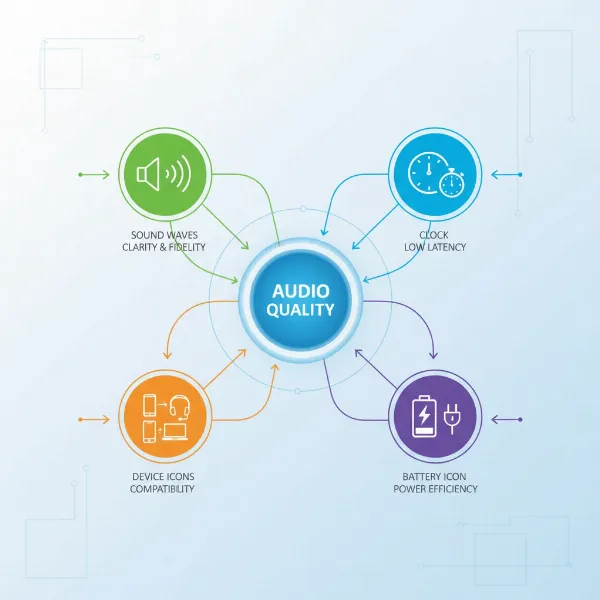 Infographic showing factors influencing Bluetooth codec choice: sound quality, latency, compatibility, battery life
Which Audio Codec is Right for You? (Buying Guide)
Deciding on the “best” audio codec ultimately boils down to your specific needs, existing devices, and listening priorities. Here’s a guide to help you navigate your choice:
Consider Your Devices
The most critical factor is ensuring compatibility between your source device (smartphone, tablet, laptop) and your receiving device (headphones, earbuds, speakers).
- If you primarily use Apple devices (iPhone, iPad, Mac): AAC will be your default and often your best-performing codec. Apple’s ecosystem is highly optimized for AAC, delivering a consistent and high-quality experience. You won’t gain much, if anything, from headphones supporting aptX or LDAC unless you also use an Android device.
- If you primarily use Android devices: You have more options. Many Android phones support aptX, aptX HD, and LDAC. Check your phone’s specifications and your desired headphones to ensure they support the same high-quality codec. LDAC is often enabled on Android 8.0+ devices.
- If you mix and match devices: Prioritize headphones that support multiple codecs. For example, headphones with both AAC and LDAC would be versatile for both iPhone and Android use, while aptX Adaptive offers broad compatibility with many Android phones and dynamically adjusts for stability.
Prioritize Your Use Case
What do you mostly use your wireless audio for?
- For critical music listening and audiophile experiences: If you listen to high-resolution audio files (FLAC, WAV) and seek the utmost detail, LDAC (at its highest bitrate) or aptX HD/Lossless are your best bets, provided your devices support them and you’re in a stable environment. Be prepared for potentially higher battery drain.
- For gaming and watching videos: Low latency is paramount to avoid frustrating audio-visual lag. aptX Low Latency or aptX Adaptive are designed specifically for this, offering minimal delay.
- For casual listening and daily commutes: AAC (especially for Apple users) and standard aptX offer excellent sound quality, good stability, and reasonable battery efficiency for everyday use, including streaming music and podcasts.
- For all-around versatility and adaptability: aptX Adaptive is a strong contender, as it intelligently adjusts to prioritize quality or low latency based on your activity and environmental conditions.
Balance Quality with Practicality
While higher bitrates and “lossless” claims are appealing, consider the real-world impact.
- Source Audio Quality: If you primarily stream from services like Spotify (which uses Ogg Vorbis at 320 kbps or AAC at 256 kbps for its web player), the benefits of ultra-high bitrate codecs like LDAC might be minimal or imperceptible to most ears. High-res codecs truly shine with high-resolution source files from services like Tidal, Qobuz, or locally stored FLAC files.
- Listening Environment: In noisy environments like a busy street or public transport, subtle audio nuances delivered by higher-quality codecs can be masked by ambient noise, making their advantages less noticeable.
- Personal Hearing: Not everyone can discern the subtle differences between advanced lossy codecs (like high-bitrate AAC or aptX) and truly lossless audio, especially as we age or in less-than-ideal listening conditions.
Comparative Table of LDAC, aptX, and AAC
Here’s a quick comparison of the key characteristics of these popular codecs:
| Feature | LDAC | aptX (Standard) | aptX HD | aptX Adaptive | AAC |
|---|---|---|---|---|---|
| Max Bitrate | 990 kbps | 352 kbps | 576 kbps | 279-420 kbps (dynamic) | 320 kbps |
| Max Sample Rate | 24-bit/96 kHz | 16-bit/44.1 kHz | 24-bit/48 kHz | 24-bit/96 kHz | 16/24-bit/44.1 kHz |
| Audio Quality | Excellent (Hi-Res Audio Wireless) | Good (Near CD-quality) | Very Good (High-definition) | Very Good (Adaptive quality) | Good (Best on Apple devices) |
| Latency | Medium (Can be higher at max bitrate) | Low | Medium | Very Low (Adaptive latency) | Medium |
| Compatibility | Android 8.0+, Sony devices | Most Android, many headphones | Many Android, hi-res headphones | Newer Android, specific headphones | Apple ecosystem, most Bluetooth devices |
| Power Cons. | Higher (at max bitrate) | Moderate | Moderate | Moderate (Adaptive) | Moderate (Efficient on Apple) |
| Best For | Audiophiles, hi-res music | General Android, balanced quality | Hi-res music on Android | Gaming, video, versatile listening | Apple users, general streaming |
Conclusion
The evolution of Bluetooth audio codecs has transformed wireless listening, moving us far beyond the basic capabilities of early Bluetooth. Codecs like LDAC, aptX, and AAC each offer distinct advantages, catering to different priorities whether you’re an audiophile chasing pristine high-resolution sound, a gamer demanding ultra-low latency, or simply a casual listener seeking reliable everyday audio.
Remember, the “best” codec is not universal; it’s the one that seamlessly integrates with your devices and enhances your personal audio experience. Consider your smartphone, your listening habits, and what truly matters most to you—be it uncompromised fidelity, zero lag, or consistent stability. By understanding these powerful technologies, you’re now equipped to choose the ideal audio companion that brings your music, games, and videos to life with exceptional clarity and engagement.
What’s your primary goal for wireless audio, and which codec do you think will get you there?
Frequently Asked Questions
What is the main difference between LDAC and aptX?
The main difference lies in their primary focus: LDAC (Sony) prioritizes very high-resolution audio transmission, offering up to 990 kbps for 24-bit/96 kHz audio, ideal for audiophiles. aptX (Qualcomm) focuses on a balance of good sound quality and lower latency, with various versions like aptX Low Latency specifically designed for minimal delay in gaming and video.
Why does AAC perform better on Apple devices than Android?
AAC is highly optimized for Apple’s hardware and software ecosystem. Apple engineers have specifically designed their devices to efficiently encode and decode AAC, resulting in consistent, high-quality audio transmission with minimal battery drain. On Android, AAC’s performance can be inconsistent as it depends heavily on the specific device manufacturer’s implementation and optimization.
Can I choose which Bluetooth codec my device uses?
Often, your devices will automatically negotiate and select the highest quality codec supported by both the transmitter and receiver. However, on some Android smartphones, you can manually select a preferred codec (like LDAC at its highest bitrate) within the developer options, though this may impact connection stability or battery life. For Apple devices, AAC is generally the default and non-adjustable option.
Do I need a special music subscription for high-resolution codecs like LDAC?
To fully appreciate high-resolution codecs like LDAC, you need high-resolution audio source files. Standard streaming services like Spotify or YouTube Music typically use compressed, lossy formats. Services like Tidal, Qobuz, Amazon Music HD, or Apple Music offer lossless and high-resolution tiers that can take full advantage of LDAC’s capabilities.
Does a higher bitrate always mean better sound quality?
While a higher bitrate theoretically allows for more audio data and therefore better sound quality, it’s not the sole determinant. The quality of the original audio source, the efficiency of the codec’s compression algorithm, the quality of your headphones, and even your listening environment significantly influence the perceived sound quality. In some cases, a well-implemented lower-bitrate codec can sound as good as or better than a poorly implemented higher-bitrate one.