Choosing between premium noise-cancelling headphones can feel like navigating a maze of technical specifications and subjective sound preferences. When the formidable Sennheiser Momentum 4 Wireless and the acclaimed Sony WH-1000XM5 stand toe-to-toe, the decision becomes even tougher. Both are titans in the industry, offering exceptional audio experiences and advanced features. But which one truly delivers the best performance for your needs and lifestyle? Let’s dive deep into a comprehensive comparison to help you determine your ideal audio companion.
Understanding Over-Ear Headphone Excellence
Over-ear headphones represent the pinnacle of personal audio, designed to fully envelop your ears for maximum immersion and comfort. They often house larger drivers, contributing to superior sound quality and a more expansive soundstage. Their design inherently lends itself to more effective passive noise isolation, which is then amplified by sophisticated active noise cancellation (ANC) technologies.
These headphones are ideal for extended listening sessions, whether you’re commuting, working in a bustling office, or simply relaxing at home. The larger form factor also allows for more substantial batteries, powering advanced features like high-resolution audio codecs, customizable sound profiles, and multi-device connectivity. While their size might be a consideration for ultimate portability, the unparalleled listening experience they offer makes them a top choice for audiophiles and casual listeners alike.
 Person wearing comfortable over-ear noise-cancelling headphones, enjoying high-quality audio experience.
Sennheiser Momentum 4 Wireless: A Closer Look
The Sennheiser Momentum 4 Wireless represents a significant evolution in Sennheiser’s acclaimed line, focusing on refined sound, exceptional battery life, and enhanced comfort. It aims to deliver a pristine audio experience that appeals to a broad spectrum of listeners, from casual users to discerning audiophiles. This model showcases Sennheiser’s commitment to balancing modern features with its heritage of high-fidelity sound.
Pros and Cons
The Momentum 4 boasts an incredibly long battery life and a sound signature that often pleases audiophiles with its detail and balance. However, its active noise cancellation, while very good, doesn’t quite reach the top tier set by some competitors. The design, while comfortable, has moved away from the more distinctive, premium aesthetic of its predecessors.
Who is it For?
The Sennheiser Momentum 4 Wireless is ideally suited for users who prioritize audio fidelity and endurance. If you’re a frequent traveler seeking extended listening times without constant recharging, or a music enthusiast who values a balanced and detailed sound profile right out of the box, the Momentum 4 is an excellent choice. It’s also great for those who prefer physical buttons over touch controls for core functions.
Sony WH-1000XM5: A Closer Look
Sony’s WH-1000XM5 arrived with a fresh, streamlined design and a renewed focus on delivering industry-leading noise cancellation and an engaging audio experience. As the latest iteration in Sony’s highly successful WH-1000X series, it builds upon a legacy of innovation, particularly in creating quiet environments for listeners. This model showcases Sony’s ambition to redefine what a premium wireless headphone can be.
Pros and Cons
The WH-1000XM5 excels with its class-leading active noise cancellation, effectively silencing distractions in almost any environment. Its sound quality is dynamic and rich, though some prefer to fine-tune it with EQ. The redesigned aesthetic offers a lighter, more seamless look, but it sacrifices the ability to fold compactly, making portability slightly less convenient than previous models.
Who is it For?
The Sony WH-1000XM5 is the perfect match for individuals who demand the absolute best in noise cancellation for travel, commuting, or busy office environments. Its exceptional microphone performance also makes it ideal for frequent calls. If you value advanced smart features and a rich, customizable sound, especially for modern genres, the XM5 is a compelling option.
Side-by-Side Comparison: Key Factors
When directly comparing these two premium headphones, several critical aspects emerge that differentiate their offerings. From how they sound to how long they last and how effectively they block out the world, these factors will guide your decision. Let’s break down the head-to-head performance.
Sound Quality
The auditory experience is paramount, and both headphones deliver exceptional performance, albeit with distinct characteristics. The Sennheiser Momentum 4 Wireless generally offers a more neutral, balanced, and audiophile-friendly sound profile straight out of the box, with impressive clarity, resolution, and a wider, deeper soundstage. It delivers a sharp and sprightly sound with plenty of substance, maintaining a detailed and musical presentation across genres.
The Sony WH-1000XM5, on the other hand, provides a more consumer-friendly sound signature, often described as slightly richer and bassier, with excellent midrange clarity and transparency. While its stock sound is good, many reviewers note that its full potential in terms of sound quality is unleashed after applying equalization (EQ) through its companion app. Its new 30mm carbon fiber driver contributes to a detailed and punchy delivery, though its virtual soundstage feature aims to create a more immersive experience.
Noise Cancellation
When it comes to silencing the world, the Sony WH-1000XM5 holds a slight edge. It features Sony’s industry-leading active noise cancellation (ANC), powered by two processors and eight microphones, which is particularly adept at blocking out constant low-frequency noise like airplane engines, as well as mid-range sounds such as ambient chatter in an office. The XM5’s adaptive ANC automatically optimizes the noise cancellation based on your surroundings.
The Sennheiser Momentum 4 Wireless offers very good noise cancellation that is effective in various everyday environments, such as a busy office or coffee shop. While it performs admirably and is a significant improvement over its predecessor, it is generally considered to be just a step behind the XM5, especially when dealing with the most challenging low-frequency rumbles encountered on flights.
Comfort and Design
Both headphones prioritize comfort for extended wear. The Sony WH-1000XM5 features a new “noiseless design,” which is sleeker, more seamless, and considerably lighter at 249g compared to the Momentum 4’s 293g. It utilizes soft synthetic leather earpads and a memory foam headband section, providing a comfortable fit with just the right amount of clamping force. However, its new design means it only folds flat, not compactly, which can be a drawback for portability.
The Sennheiser Momentum 4 Wireless is widely praised for its comfort, even during very long listening sessions. It features wider earcups that accommodate larger ears, and softer earpad filling that gently distributes clamp force. The headband is covered in a fabric texture, giving it a distinct feel. While comfortable, its design has shifted towards a more conventional aesthetic compared to the Momentum 3, and like the XM5, it doesn’t fold compactly for travel.
Battery Life
This is one area where the Sennheiser Momentum 4 Wireless truly shines, offering a remarkable 60 to 62 hours of continuous playback with ANC enabled. This makes it one of the longest-lasting over-ear headphones on the market, ideal for intercontinental flights or weeks of casual use without needing a recharge.
The Sony WH-1000XM5 provides a substantial 27 to 30 hours of battery life with ANC on, extending to around 40 hours with ANC off. While this is impressive for most users and a solid improvement over its predecessors, it is significantly less than what the Momentum 4 offers. Both headphones support fast charging, with the Momentum 4 giving 6 hours of playback from a 10-minute charge, and the XM5 providing 3 hours from a 3-minute charge.
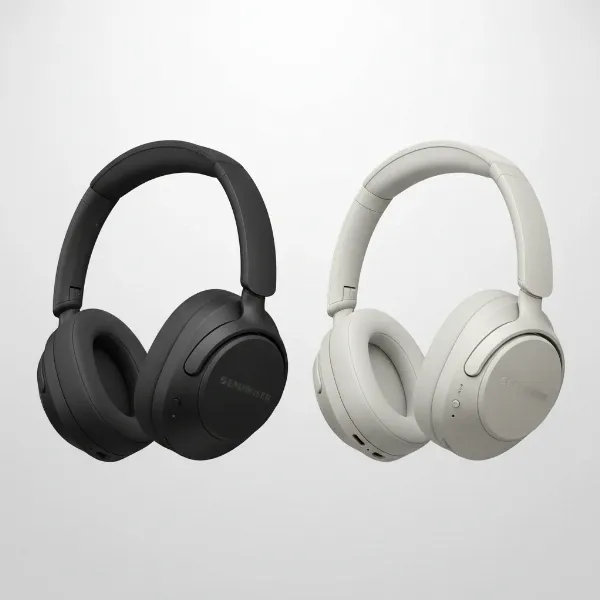 Side-by-side comparison of Sennheiser Momentum 4 Wireless and Sony WH-1000XM5 headphones.
Connectivity and Features
Both headphones offer a robust suite of connectivity options and smart features to enhance the user experience.
Wireless Connectivity Standards
The Sony WH-1000XM5 supports Bluetooth 5.2 and includes Sony’s proprietary LDAC codec for high-resolution audio streaming from compatible devices. It also supports SBC and AAC. The Sennheiser Momentum 4 Wireless also uses Bluetooth 5.2 and boasts support for aptX, aptX HD, and aptX Adaptive codecs, which are widely regarded for delivering high-quality, low-latency audio.
Both models offer multipoint connectivity, allowing them to connect to two devices simultaneously and switch seamlessly between them. However, with the XM5, using LDAC for high-res audio streaming is not possible when multipoint is active.
App Integration and Smart Controls
The Sennheiser Smart Control app allows for adaptive ANC, an adjustable EQ, and a unique “Sound Personalization” feature that calibrates a custom audio profile based on user reactions to sound samples. It also offers “Sound Zones,” enabling up to 20 custom profiles with specific EQ and noise isolation levels that activate based on your location.
The Sony Headphones Connect app offers detailed EQ customization, control customization, and support for Sony’s 360 Reality Audio feature. Key smart features include “Speak to Chat,” which pauses music and engages ambient sound when you start talking, and improved “Wearing Detection,” which automatically pauses/restarts playback when the headphones are removed/donned. The XM5 also features a virtual assistant integration.
Microphone Quality
The Sony WH-1000XM5 generally has a superior microphone system, utilizing four beamforming mics and AI-powered noise reduction for crystal-clear calls, even in noisy or windy conditions. This makes it an excellent choice for business calls or online meetings. The Sennheiser Momentum 4 Wireless also has a very good microphone, capable of clear phone and Zoom calls in ideal conditions, but it doesn’t quite match the XM5’s impressive external noise rejection.
Which is Better? Making Your Choice
Deciding between the Sennheiser Momentum 4 Wireless and the Sony WH-1000XM5 ultimately comes down to your personal priorities and typical usage scenarios. Both are exceptional headphones, representing the pinnacle of wireless audio technology, but they cater to slightly different preferences.
If unrivaled noise cancellation and smart features are at the top of your list, the Sony WH-1000XM5 is likely the better choice. Its ability to silence the world around you, especially constant low-frequency hums and mid-range chatter, is unparalleled, making it perfect for frequent flyers and commuters. The XM5’s superior microphone quality also makes it a strong contender for those who make many hands-free calls.
However, if audiophile-grade sound quality, extended battery life, and overall value are more important, the Sennheiser Momentum 4 Wireless could be your ideal match. Its balanced, detailed sound profile requires less EQ tinkering, and its industry-leading 60-hour battery life means you’ll spend less time charging and more time listening. The Momentum 4 often provides comparable premium features at a slightly more accessible price point.
Consider what truly matters for your daily listening experience. Do you crave absolute silence, or do you prioritize a rich, natural sound that lasts for days on end? Answering these questions will guide you to the pair that best fits your world.
Frequently Asked Questions
Do either the Sennheiser Momentum 4 or Sony WH-1000XM5 support wired listening?
Yes, both the Sennheiser Momentum 4 Wireless and the Sony WH-1000XM5 come with a 3.5mm audio cable, allowing for wired listening, which is beneficial if the battery dies or for connecting to non-Bluetooth devices. The Momentum 4 also uniquely supports audio playback via its USB-C port.
Are these headphones suitable for working out?
While both headphones are comfortable for general use, neither the Sennheiser Momentum 4 nor the Sony WH-1000XM5 has an official IP rating for water or sweat resistance. Therefore, they are not ideal for intense workouts where they would be exposed to significant moisture, and using them for exercise could risk damage.
Can I customize the sound profile of these headphones?
Absolutely. Both headphones feature comprehensive companion apps (Sennheiser Smart Control and Sony Headphones Connect) that offer detailed equalizer (EQ) adjustments. You can create custom sound profiles, choose from presets, and even utilize advanced features like Sennheiser’s Sound Personalization or Sony’s 360 Reality Audio to tailor the audio to your liking.
How do their designs impact portability for travel?
Both the Sennheiser Momentum 4 Wireless and Sony WH-1000XM5 feature designs that allow their earcups to lie flat, fitting well into their included carry cases. However, neither model folds compactly into a smaller ball shape like some older designs (e.g., Sony WH-1000XM4). This means their cases will take up a bit more space in your bag compared to foldable alternatives.
Which headphone offers better compatibility with different audio codecs?
The Sennheiser Momentum 4 Wireless supports aptX, aptX HD, and aptX Adaptive, making it a versatile choice for devices that support these codecs, particularly Android phones. The Sony WH-1000XM5 supports LDAC, Sony’s high-resolution audio codec, which is excellent for compatible Sony devices and certain Android phones. Both also support the standard SBC and AAC codecs, ensuring good quality across all Bluetooth devices.